
|
Scientists Fear Irreparable Loss of Peanut Crop Biodiversity for World Food Supply New Pipeline in South America Delays Search for Wild Peanut Ancestors Critical To Producing Drought and Disease Resistant Crops | |||||
|
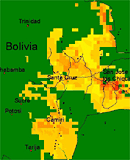
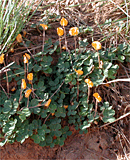
Scientists announced today that the completion of a new US$2 billion natural gas pipeline running through Bolivia to Brazil is endangering one of the last remaining habitats for wild peanuts. Urgent efforts to collect samples of these wild peanut species, many as yet undiscovered, have been delayed indefinitely due to backlash surrounding the pipeline project from indigenous groups in Bolivia. The pipeline runs through a remote area in the Gran Chaco region of southeastern Bolivia, where past experience coupled with new research has shown wild peanut species are most likely to be found, including one of the most sought-after wild peanut species still undiscovered. "Although the pipeline is bringing much-needed natural gas to Brazil, the stakes are high," says researcher David Williams. "The species we are looking for could eliminate much of the need for peanut farmers to use pesticides and also help them to cope with drought and disease." Williams, a plant explorer and ethno-botanist, is based in Cali, Colombia at the Americas Office of the International Plant Genetic Resources Institute (IPGRI), a Future Harvest Center of the Consultative Group on International Agricultural Research (CGIAR). Peanuts, also known as groundnuts, are grown in 108 countries. Last year, worldwide production totaled 35 million tons, with the vast majority taking place in Asia and Africa. While eaten mainly as snack food or as peanut butter in North America and Europe, peanuts are widely grown in developing countries as an important source of protein and oil in human diets. Peanuts are susceptible to a long list of pests and diseases that can greatly reduce yields. "Enhancing today's peanut varieties with the genes from the crop's wild ancestors would benefit farmers and consumers around the world, especially the poor," says Williams. "We know there are more wild peanuts to be collected in the Chaco region, and we know that they're threatened." Williams' contention is based on experience from previous plant-collecting missions and on new information provided by a computer tool known as FloraMap™—software developed at the International Center for Tropical Agriculture (CIAT), a Future Harvest Center of the CGIAR. The pipeline project has opened up remote areas to settlers and large-scale agricultural development. "These are places where wild peanuts have survived undisturbed for thousands of years," notes Williams. "Groundnut is one of the world's most important food crops," says William Dar, Director General of the International Centre for Research in the Semi-Arid Tropics (ICRISAT), a Future Harvest Center of the CGIAR. "The availability of one of the original parents of today's cultivated varieties would be an enormous addition to national and international peanut collections and would aid breeding efforts for poor people who depend upon peanuts as an important source of protein and oil." Construction of the pipeline and the establishment of new farms and ranches along feeder roads mobilized indigenous groups to oppose further encroachment, ironically including the collection of native plant species. "The backlash from the pipeline controversy," Williams says, "has inadvertently put pressure on the Bolivian government to withhold the permits that scientists need to remove wild peanut samples for safekeeping. But we have strong support from Bolivia's Ministry of the Environment and from the Bolivian scientific community who recognize what's at stake if we don't get in there in time and start collecting." If the ban is eventually lifted, as Williams and his Bolivian colleagues hope, duplicate samples would be provided to Bolivian research organizations, to the United States Department of Agriculture (USDA), and to the world peanut collection at ICRISAT based in Hyderabad, India, which houses nearly 15,000 different types of cultivated and wild groundnuts. Roughly 90 percent of the world's peanut crop, Dar notes, is grown in developing countries, often in areas with poor soils and inadequate rainfall. While North American farmers grow less than 8 percent of the world's peanuts, their yields are three to five times higher than farmers in South Asia and Africa. The peanuts that people eat today first evolved through a chance cross between two wild species, says Williams. "No one knows exactly when or where the cross occurred, but our best guess is that the two species combined around six to eight thousand years ago." Researchers note that over the centuries farmers and plant breeders unintentionally "switched off" many useful genes that were present in the first crosses between wild species. "If we can put back into modern varieties some of the disease and drought resistant genes from the ancient ancestors of groundnut, we should be able to give Asian and African farmers a helping hand," Dar says. "It's an achievable goal, but will require us to move quickly before the native habitat of the crop's ancestors is further altered." Today, there are 68 known wild peanut species. Williams estimates, however, that there are perhaps 15 to 20 undiscovered species that could still be collected. Topping the list is a wild peanut known to scientists as the B-genome parent. The B-genome species is believed to be one of the original parents of today's domesticated peanut, but has never been conclusively found in nature. "It's the holy grail of peanut evolution," Williams says. If the original B-genome wild parent can be found, scientists will be able to reconstruct the types of peanuts that humans first ate more than 5,000 years ago, notes Charles Simpson, a leading international peanut expert and researcher at Texas A&M University. Simpson admits that no one knows exactly what characteristics the missing wild B-genome parent contains until it is collected. "We think it's out there, and it's sure to be endangered," he says. "I just hope we can find it in time." A previous expedition to the Chaco region by Simpson, Williams, and others in 1994 and new information provided by FloraMap indicate that the B-genome peanut is most likely to be found in a small unexplored area of this region on the border between Bolivia and northwest Paraguay. "This particular area is also likely to be subject to rising temperatures and changes in rainfall caused by global warming, which makes collection there all the more urgent," says Andrew Jarvis, a CIAT researcher working with Williams on mapping where the sought out species are likely to be found. "Locating and collecting samples of these wild peanut species would be a major breakthrough for agricultural science," says Williams. "If found, the benefits of transferring—using conventional breeding techniques—disease and drought resistance of wild peanuts into domesticated peanut varieties are enormous. Otherwise, farmers and consumers around the world face an irreversible loss." ### Future Harvest (http://www.futureharvest.org/) is a foundation that builds awareness of global public issues related to food security, health, poverty, and the environment. Future Harvest promotes agricultural research through offices and partnerships extending across the world. Future Harvest is an initiative of 16 food and environmental research centers supported by the Consultative Group on International Agricultural Research. The International Plant Genetic Resources Institute (IPGRI) (http://www.ipgri.org/) is dedicated to advancing the conservation and use of plant diversity for the well being of present and future generations. It is the world's largest international institute dedicated solely to the conservation and use of plant diversity. IPGRI is a Future Harvest Center supported by the Consultative Group on International Agricultural Research. The International Crops Research Institute for the Semi-Arid Tropics (ICRISAT) (http://www.icrisat.org/) works to help developing countries apply science in order to increase crop productivity and food security, reduce poverty, and protect the environment. ICRISAT focuses on the semi-arid tropical areas of the developing world, where low rainfall is the major environmental constraint to agriculture. ICRISAT is a Future Harvest Center supported by the Consultative Group on International Agricultural Research. The International Center for Tropical Agriculture (CIAT) (http://www.ciat.cgiar.org/) is a not-for-profit organization that conducts socially and environmentally progressive research aimed at reducing hunger and poverty and preserving natural resources in developing countries. CIAT is one of 16 Future Harvest Centers supported by the Consultative Group on International Agricultural Research working toward these goals around the world in partnership with farmers, scientists, and policy makers. The Consultative Group on International Agricultural Research (CGIAR) (http://www.cgiar.org/) is a strategic alliance of 58 members and 16 Future Harvest Centers that mobilizes cutting-edge science to promote sustainable development by reducing hunger and poverty, improving human nutrition and health, and protecting the environment. Learn more about genetic conservation at: http://www.startwithaseed.org/
Learn more about groundnut research at the Future Harvest Centers
at: www.futureharvest.org/earth/groundnuts_feature.shtml Other useful sites: http://stephenville.tamu.edu/~csimpson/index.html |
For Further Information, Contact:
For more information... FloraMap: A New Tool for Finding and Conserving Biodiversity
| ||||



 |
Read Previous Notes |
 |
|
 |
 |
|
