 |
|||||
| Pod Borer Plague Stopped Short
Virus Naturally Controls Deadly Enemy of Farmers |
|||||
|
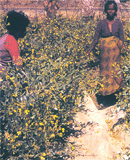
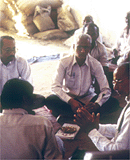
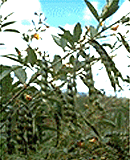
3 February 2004 — "The pod borers came and devoured our crops before the NPV spray, now I see better crops and fewer holes in my pigeonpea pods, and I know that the food we are growing is not harming our environment" Mr. G. P. Wanjare, farmer from Ashta, India. Tucked away in West Central India in the Kinwat tribal area of Maharashtra, a village called Ashta plants cotton, pigeonpea, and chickpea to provide food and income to some 1,400 inhabitants. Known for its expansive skies and hardworking farmers, Ashta is now also the center of a major breakthrough in agriculture, one that could potentially help farmers around the world combat one of the most pervasive agricultural pests. Farmers in Ashta have long been known for their quick adoption of new agricultural practices. In the 1960s and 70s, Ashta's farmers were among the first to adopt new technologies and crop varieties that increased agricultural output in India. Ashta farmers later adopted synthetic insecticides to reap better and bigger harvests of cotton, pigeonpea, sorghum and chickpea in the 1980s. Success using these chemically based methods was encouraging, but did not last. After a period of good years, successful farming required increasing investment in pesticides and yielded decreasing profits from crops. Return of the Insects Continuous use of insecticides led to increased resistance among the targeted pests, and a traditional enemy of farmers made a dramatic comeback. No longer responding to conventional chemicals, a pod borer epidemic hit Ashta with the characteristic orange and brown striped caterpillars chewing through flower buds, flowers, and maturing seeds, and ruining crops from the mid- to late 90s. The pod borer, Helicoverpa armigera, attacks nearly 200 crops including cotton, beans, cereals, vegetables, and fruits. Global losses from pod borer amount to some US$2 billion every year. An additional US$500 million is spent annually on insecticides to control this voracious caterpillar. Pigeonpea is an inexpensive, high-protein food common to South Asia and East Africa. Pigeonpea comes in a variety of shapes and colors and grows in bountiful quantities on bushes loaded with pods. The pod borer is especially damaging to pigeonpea. Losses can reach 20- to 100-percent of crops. With the return of the pod borer, Ashta's pigeonpea farmers needed help. They sought assistance from international agricultural research organizations including the International Crops Research Institute for the Semi-Arid Tropics (ICRISAT). NPV: a Recipe for a Pod Borer Control Nuclear Polyhedrosis Virus (NPV) is a naturally occurring viral disease of pod borers that causes heavy mortality in pod borers but no deleterious effect on non-target insects, animals, or crops. However, the large-scale use of NPV against the pod borer was limited in the past for a simple reason: NPV production requires live host insects and is thus difficult to produce in large quantities. ICRISAT in collaboration with a host of regional, national, and international partners and donors* found a way to overcome this technical hurdle and increase the availability of the virus for human benefit. Traditional Solution, Modern "Twist" To control the pod borer, farmers collect pod borer larvae from the field by shaking pigeonpea. In days before chemical sprays, experienced farmers would walk through their fields shaking pigeonpea plants until the pod borers fell from the plants onto blankets and into sacks at which point they were destroyed. Reintroduced in recent years, this traditional, cost-effective method reduces pod borer infestations by 85 percent or more. Today, ICRISAT and partners augment this effective technique with modern science in order to create another weapon against pod borer. Researchers have now found a way to manufacture NPV into an easy-to-apply spray. Next Step: Pod Borer Puree To develop the spray, farmers and researchers collect live pod borers by shaking the pigeonpea plants. The caterpillars are then reared in individual compartments and fed an exclusive diet of NPV-infected chickpea seeds, until they die of the virus—the point when maximum viral production is achieved. "It is necessary to keep the pod borers in separate compartments to avoid cannibalism," says Dr. GV Rango Rao of ICRISAT. "At every step, traditional control methods have been married to modern science to gain the most ground in the race against the pod borer." The podborer carcasses that show clear evidence of virus are mixed and macerated in a blender with clean water. Blending the caterpillars crushes the insect tissue and releases the NPV in a form that can infect healthy pod borers. Researchers then spin the mixture again in a machine called a centrifuge at 5,000 revolutions per minute to separate the virus and to improve quality and purity of viral agent. Later, this mixture is assessed for quality before storage in special ultraviolet protected opaque bottles. Farmers Make it Work Controlling the pod borer requires an integrated strategy that includes pheromone traps that fool the pod borer adults by simulating the scent of a potential mate. By measuring the infestation level with the pheromone traps and evaluating effectiveness of control in a range of conditions, researchers can train farmers to apply NPV spray at just the right time. Researchers also teach farmers how to maintain these traps and help them establish perches to encourage insectivorous birds. The new methods represent an emerging philosophy for controlling insect pests using natural enemies, part of a strategy known as Integrated Pest Management. In the past, Indian farmers depended on chemicals to control the pod borer, applying some five- to eight-sprays of different chemicals, a frequency that directly led to the resistance in the pod borer in Ashta. Today, Ashta's farmers spray NPV, avoid the cycle of developing insect resistance, and gain more profits without environmental harm. "This simple technology has enabled farmers to protect their chickpea, pigeonpea, cotton, and vegetable crops at very low cost, and without chemicals" says Dr. Rao. "This benefits villages both in terms of income and the environment." NPV production costs only a fifth as much as alternative, commercially produced chemical sprays and leaves no chemical residues that can harm human health and the environment. In Ashta, where the entire village adopted the technology, farmers did not use even a single spray of chemical insecticide and achieved yields that more than doubled the results of neighboring villages for pigeonpea, chickpea and cotton crops. Following the initial success of the NPV technology in the seven villages in 1999 and 2000, more than 100 farmers and extension specialists from India, Bangladesh, Nepal and Kenya have been trained in the IPM methods and use of this new weapon in the arsenal against pod borer. Farmers have further popularized NPV both in regional agricultural fairs and through the media. "We are now looking at how we can work with our partners and donors to use these strategies to scale up incomes for people in East Africa and Asia," says Dr. Rao. "While pesticides may have their place in some cases, Asian agriculture is often spoiled through inappropriate and non-judicious use of toxic chemicals for plant protection. ICRISAT and its partners are now encouraging NPV as a means to minimize pesticide use and improve profits throughout the region, with better results for both environmental and human health." For Mr. G.P. Wanjare , a small-scale farmer in Ashta, farming with NPV is simply about making a better living. "I welcome this little virus like a friend. It has meant better pigeonpea crops and more income for me and my family," he says.
For further information, please contact: PARTNERS
Bangladesh
India
Kenya
Nepal Donors
Asian Development Bank |


|
||||