 |
|||||
| Legumes Leveraged
ICRISAT Links Farmers with Markets in East Africa |
|||||
|
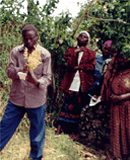
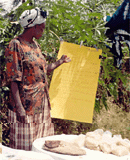
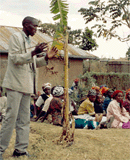
14 January 2004 — "This area has its own way of selecting for suitable crops. This time it has selected chickpea and pigeonpea, and we really like these crops," says Mr. Alfred Korir, a Kenyan farmer. Mr. Korir is benefiting from a unique program designed to increase his income that is guided by agricultural researchers from around the world. More than half of the largely rural population in eastern Africa lives in extreme poverty. This means families in Korir's community often do not have enough to eat, and parents often lack the income needed to provide for their children's education and future. Legume crops, which include peas and beans, may provide part of the solution to the poverty faced by Korir and his community. The key is a unique marketing and sales approach for pigeonpea and chickpea spearheaded by the International Crops Research Institute for the Semi-Arid Tropics (ICRISAT) and its partners. This approach has led to enhanced bargaining power and enabled farmers to increase their selling price by 45 percent on average — in some cases, doubling the price they receive in local and regional markets. "We are now looking at how we can work with our partners and donors to use these strategies in scaling up incomes of people throughout East Africa," says Dr. William Dar, Director General of ICRISAT. Selecting crops for improved incomes and rural welfare Since 1999, ICRISAT researchers have been developing high-yielding pigeonpeas from locally adapted varieties and high-yielding chickpeas from internationally available varieties. In all, researchers introduced over 500 varieties of these crops from India and other locations around the world. ICRISAT scientists based in Nairobi, Kenya first evaluated chickpeas and pigeonpeas to determine the varieties with the highest profit potential and suitability to local conditions. Researchers then distributed the best-adapted varieties to local farmers and scientists through national agricultural research programs in Kenya and Tanzania. After further field tests, the top varieties were planted in demonstration plots from which farmers were able to save seed. Then, researchers working with farmers established plots dedicated to producing seed, allowing more seed to be distributed rapidly to fields in the hot eastern part of Kenya and the Rift Valley. Catholic Relief Services, an international charity active in Africa, and its partners are now expanding chickpea and pigeonpea production in Shinyanga and Mwanza regions of Tanzania, and the Mbeere district of Kenya. Initial results have been surprising. Grain yields of the highest-yielding varieties of chickpeas were over 4 tons per hectare in the test fields, with more than 80 percent of new introduced varieties producing greater yields than typical pre-introduction harvests in both countries. But that's only half the story. New policy that encourages collaborative bargaining is enhancing rural farmers' market power and has meant that farmers can increase the income they gain from planting the new seeds. After ICRISAT grows the initial planting seed on research fields provided by the Kenya Agricultural Research Institute and the University of Nairobi, the seed is circulated to farmer organizations called Producer Marketing Groups (PMGs). The PMGs distribute seed to a few dozen farmers that plant to produce high quality seed for still more farmers to grow for food and sale. Farmers working in the PMGs pool their produce and sell it collectively in order to gain better prices and more income. "People in this area sometimes fear trying new things, but this time around they tried these crops and they have proved to be very good," says Ms. Catherine Sigira a farmer from Kiplabotwa, Kenya. The Producer Marketing Groups have also improved her ability to manage her crops and improve her family's income, she adds. Ms. Sigira's experience is far from isolated. In the first year in Kenya, some 50 tons of pigeonpea grain valued at Kenya shillings 800,000 (USD 11,000) was marketed by 200 farmers in Makueni and over 30 tons of chickpea grain valued at 900,000 Kenya Shillings (USD 12,000) was marketed by farmers in Mbeere District. "We expect a similar high volume of chickpeas and pigeonpea sales from the Rift Valley, and perhaps twice that amount in Tanzania," says Dr. Dar. Local farmers and community leaders see the benefits of the work and express their sense of empowerment. "We are here to make things happen, not see things happen," says James Kosgei Area Chief, Kiplabotwa, Kenya. "We can assure you that this project will continue to be a big success, and our region a leading producer." For further information, please contact: Partners
Donors
|

For more information... More pictures of Chickpea and Pigeonpea

|
||||