
Farm
Economy Outlook
January
2002
Slide 1
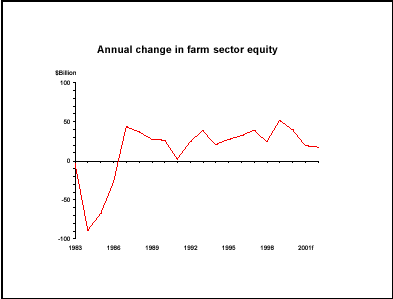
Farm-sector
equity is expected to increase for the 16th consecutive year, even though
prices for major grains remain relatively low.
During
the 1990s, farmland owners experienced continued growth in equity, not
only
The
new decade has continued the trend of rising farm real estate values.
Current evidence indicates that farm net worth will grow by about $17
billion in 2002.
Slide
2
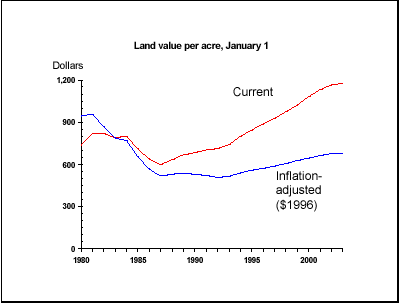
Government
payments, particularly emergency assistance, have bolstered returns from
farming and increased farmland values in recent years. The value of U.S.
farm real estate is expected to rise by about 1 percent in 2002. This is
slower than the 4-percent annualized land value appreciation rate during
1998-2001.
Still,
farmland values are expected to increase in real terms in 2002, rising at
a rate that exceeds inflation for the 10 th consecutive year. Among the
factors contributing to growth in land values are: net returns to farming,
and demand for farmland for nonagricultural purposes such as housing and
recreation.
Slide
3
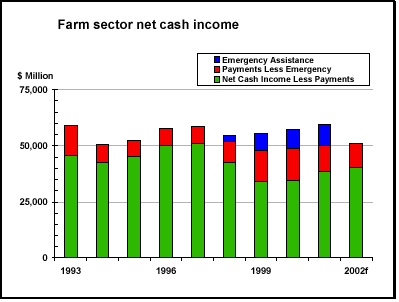
Net
cash income before government payments is expected to increase for the
third straight year and exceed $40 billion for the first time since 1998.
Improvement in market earnings is being driven by increases in both crop
and livestock receipts. In 2002, livestock receipts will have increased
over $10 billion and crop receipts $5 billion from their respective 1998
and 1999 lows.
Slide 4
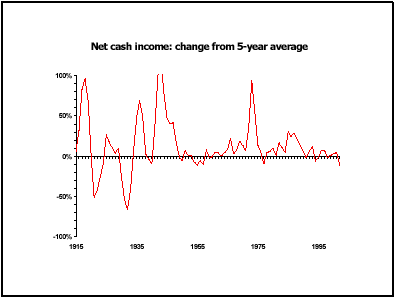
With
government payments assumed to be less than those made in 2001, the 2002
forecast for net cash income is 10 percent below the 5-year moving
average, indicating a potentially tighter cash position for the sector.
The
draw down in cash income relative to longer term trends is due entirely to
the assumed reduction in government payments forecast for 2002, since
market receipts will rise by an amount more than sufficient to offset the
relatively small increase in production expenses.
Slide
5
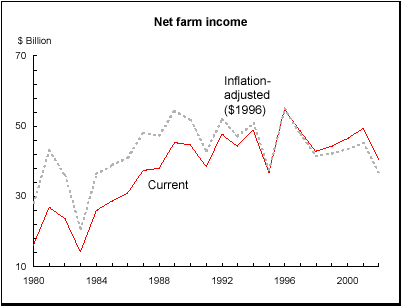
Net
farm income is forecast at $40.6 billion in 2002. This would be $8.7
billion less than 2001’s forecast (which included $9.1 billion in
emergency assistance passed last summer) and $5.8 billion below the
1992-2001 average.
Supported
by over $21 billion in government payments, 2001’s net income of $49.3
billion was exceeded only by the record $54.9 billion earned in 1996.
Growth
in income during 1998-2001 exceeded changes in inflation and improved the
farm sector’s earnings relative to the general economy.
Slide
6
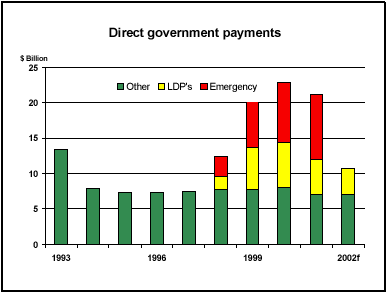
Both
Congress and the Administration have discussed additional payments for
2002. However, payments will likely be less this year than the $21 billion
distributed in 2001.
Emergency
assistance originating from special legislation comprised $9.1 billion of
total government payments in 2001. Higher crop prices will result in
nearly $1.3 billion less in loan deficiency payments, which were also a
significant component of total payments in 2001.
Slide
7
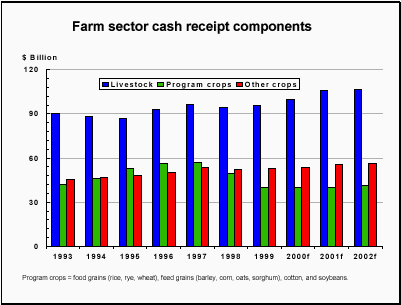
The
value of crop output will continue its 3-year pattern of growth, and
livestock output value will also continue rising. Cash receipts are
expected to be up about $1 billion for feed grains, cotton, and oil crops.
Among the major crops, only cotton and rice have prospects of lower 2002
cash receipts.
Relatively
low feed costs, strong domestic demand, and gains in export sales have
encouraged higher pork and beef output. Receipts from dairy product sales
are forecast to retract by $2.3 billion in 2002, but that follows a
$4.1-billion gain last year.
Slide 8
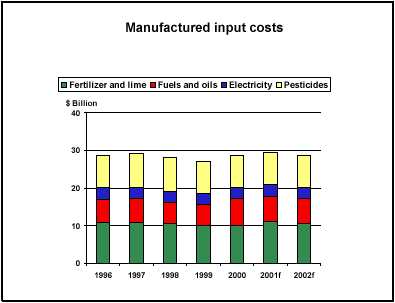
Manufactured
input costs, after 2 consecutive years of increases, should decline in
2002. Fuel expenses are forecast down 7 percent in 2001 and another 2
percent in 2002, and will be at their lowest level since 1998.
Fertilizer
prices are slated to fall about 5 percent, while small increases will
likely occur in pesticide prices.
Slide 9
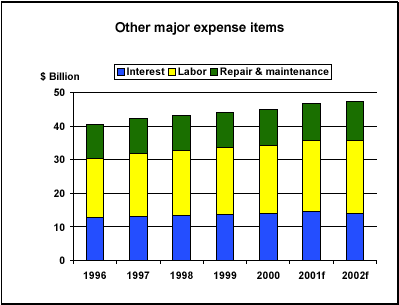
Compensation
for hired labor will continue to rise in 2002, while land rent and
interest expenses will be less than in the last 3-5 years.
Labor
expenses are expected to increase more than 3 percent, the result of a
slight rise in total labor use and an increase in wage rates. This
compares with higher (4-percent) increases during the preceding 5 years,
and corresponds with changes in the national economy.
The
reduction in interest expense will result from a slight decrease in real
estate interest and a near 7-percent drop in non-real estate (short-term)
interest. The decrease in both types of interest expenses is the first
since 1993.
Slide 10
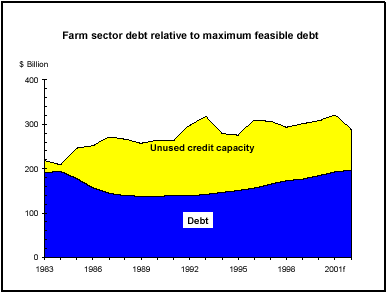
Despite
an anticipated $4-billion increase in farm business debt, the U.S.
farm-sector balance sheet is expected to improve slightly in 2002.
Anecdotal
evidence suggests that farmers may be refinancing farm debt to take
advantage of lower interest rates and, responding to tax incentives,
converting nondeductible personal debt into farm business debt.
Reduced
farm income levels in 2002 means that many farm operators will have less
income available to meet their debt-service obligations. The maximum debt
that farm operators could service with current income is expected to
decrease by 10 percent in 2002. Coupled with the 2-percent rise in farm
debt, farm operators’ use of their debt-repayment capacity (ratio of
actual debt to maximum debt) is expected to rise from 60 percent in 2001
to 68 percent in 2002.
Slide 11
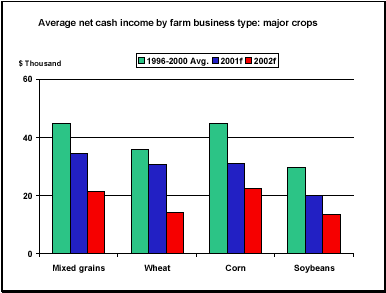
The
projected 15-percent decline in farm-sector net cash income for 2002 will
not be equally distributed across all farm operations.
Cash
grain and soybean farm businesses are expected to have lower average net
cash income, due largely to declining government payments. Corn, wheat,
and soybean farms will have higher market receipts and lower expenses in
2002.
Higher
earnings from commodity sales will not be sufficient to overcome the
reduction in government payments for these farms. Payments that equaled
about 20 percent of corn and soybean farm revenue and 30 percent of wheat
farm revenue in 2001 are forecast to be about half their 2001 levels in
2002.
Slide 12
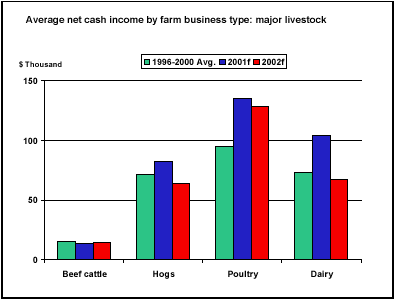
Income
prospects for livestock farm businesses have been more favorable in recent
years, although a combination of higher feed costs, lower payments, and
for dairy and hog farms, lower receipts, may reduce 2002 earnings.
Beef
farms will earn higher receipts and will most likely have stable expenses.
But, these gains will not be sufficient to offset lower payments earned
from participation in government programs.
Dairy
and hog farms will face lower receipts, higher expenses, and lower
payments, accounting for overall reductions in income in 2002 that
resemble those for the major grain farms. Even if payments were restored
to 2001 levels, these farms would still face lower incomes due to higher
input costs and lower receipts.
Slide 13
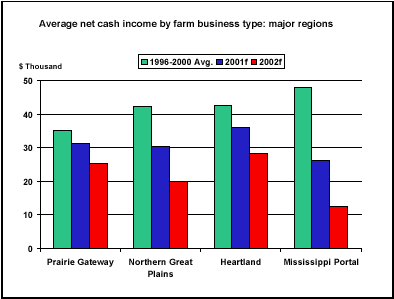
The
largest declines in average net cash income for farm businesses are
expected in regions most dependent on government payments.
In
the Prairie Gateway, Northern Great Plains, Heartland, and Mississippi
Portal, higher market receipts and lower production expenses will not be
sufficient to offset the reduction in government payments forecast for
2002.
Slide 14
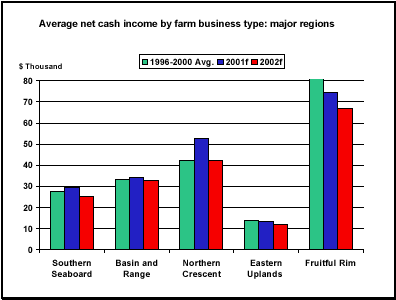
In
regions less dependent on government payments, average net cash income is
expected to be relatively steady.
In
the Southern Seaboard, Basin and Range, Northern Crescent, Eastern
Uplands, and Fruitful Rim, changes in receipts and expenses tend to be
offsetting. Government payments contribute less to income in these
regions, leaving changes in the income forecast for 2002 at a more
moderate level.
Slide 15
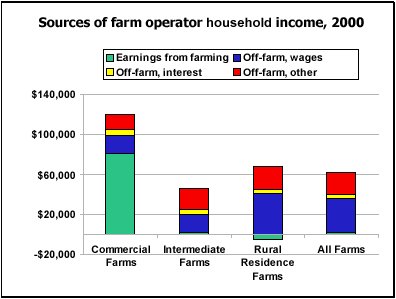
Farm
households hold a wide variety of off-farm jobs and investments.
On
two-thirds of farms, the operator, spouse, or both work at some off-farm
job. Off-farm work is sought not just by operators of rural residence and
other smaller farms.
Over
40 percent of spouses and 20 percent of operators of commercial-size farms
hold off-farm jobs.
Farm
households earn income from multiple and diverse sources of employment and
investment. Households of commercial-size farms, though more dependent on
farm earnings, draw income from wages, investments, and other businesses
owned by the family. Off-farm wages and self-employment earnings are the
most dominant sources of income for families operating intermediate and
rural resident farms.
Slide 16
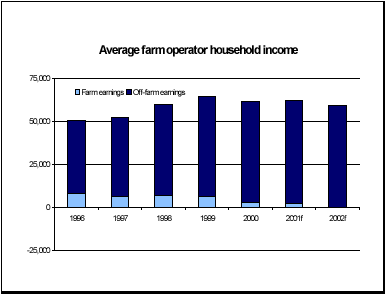
After
rising each year in the late 1990s, farm household income leveled off last
year and is expected to decline very slightly this year.
Farm
operator household incomes are projected to be lower in 2002, the result
of lower earnings from both farm and off-farm sources.
Slightly
higher receipts, on average, combined with stable production costs will
not be sufficient to overcome the lower level of government payments
projected for 2002. The result will be lower cash incomes on average.
Off-farm
earnings are also projected to be lower in 2002, reflecting changes in the
general economy: lower interest rates and changes in job status can affect
investment earnings and job wages.
By
Mitch Morehart, Bob McElroy, James Johnson
Economic Research
Service, U.S. Department of Agriculture


 |
Previous articles
|


 |
|
