Agronomic Practices to Stretch Limited
Water
Supplies
Crop production considerations for producers facing limited water include plant populations, residue management, water timing, and soil fertility.
Plant Populations
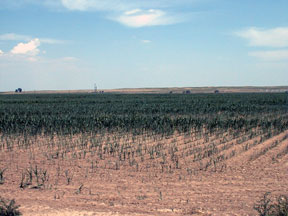 Plant populations for dryland production have traditionally been
less than for irrigated production. Populations are reduced to better
match precipitation and stored soil water to crop ET. However, populations
on irrigated corn must be reduced to less than 18,000 plants/acre to
reduce ET significantly. Lamm and Trooien (2001) found that corn grain
yields generally increased as plant populations increased from 22,000
plants/acre to 34,000 plants/acre for varying irrigation capacities.
Little yield penalty was observed at higher plant populations compared to
lower populations when no irrigation was applied. Therefore, if corn is
grown for irrigated production, even limited, then producers should stay
with their normal populations. If the intent is to grow dryland corn with
no irrigation, then a dryland population (12,000 to 18,000 plant/acre) is
the best option.
Plant populations for dryland production have traditionally been
less than for irrigated production. Populations are reduced to better
match precipitation and stored soil water to crop ET. However, populations
on irrigated corn must be reduced to less than 18,000 plants/acre to
reduce ET significantly. Lamm and Trooien (2001) found that corn grain
yields generally increased as plant populations increased from 22,000
plants/acre to 34,000 plants/acre for varying irrigation capacities.
Little yield penalty was observed at higher plant populations compared to
lower populations when no irrigation was applied. Therefore, if corn is
grown for irrigated production, even limited, then producers should stay
with their normal populations. If the intent is to grow dryland corn with
no irrigation, then a dryland population (12,000 to 18,000 plant/acre) is
the best option.
Residue Management
The goal when
working with limited water is to capture every possible source of water in
the production system. These sources include rainfall, snowfall and
irrigation water. Residue management can have a significant impact upon
increasing the availability of water. Runoff from precipitation and
irrigation is also reduced when surface residue is present. Residue acts
as small dams that slow water movement and allow more time for the water
to infiltrate into the soil. Residue also reduces the impact of rainfall
and irrigation upon surface sealing which increases infiltration rates. As
droplets impact the soil surface, they destroy the surface structure which
will seal the soil surface and reduce infiltration rates. Residue protects
the soil surface from the impact of these droplets. Many benefits of
increased residue on evaporation losses and stored soil moisture are
covered in more detail in articles by Klocke and Nielsen in this issue of Agronomy News.
Crop Rotations and Water Timing
Crop rotations
that have lower water use crops (see article by Schneekloth) can reduce
irrigation needs. Schneekloth et al. (1991) found that when limited to 6
inches of irrigation, corn following wheat yielded 13 bu/acre (8 percent)
more than continuous corn. The increased grain yield following wheat was
due to increased stored soil moisture during the non-growing season that
was available for ET during the growing season. Crop rotations also spread
the irrigation season over a greater time period as compared to a single
crop. When planting multiple crops such as corn and winter wheat, the
irrigation season is extended from May to early October as compared to
continuous corn, which is predominantly irrigated from June to early
September.
Some systems can never meet crop ET, even with normal precipitation. O’Brien et al. (2001) found that when irrigation system capacity was increased from 0.1 inches/day to 0.2 inches/day yields increased by 28%. To achieve this change in capacity per irrigated acre, a producer would have to reduce irrigated acres by 50%. Profitability of increasing the irrigation capacity by reducing irrigated acres increased net returns per irrigated acre by nearly 4 times. Though only half of the acres were irrigated, profits were more than twice that of irrigating the entire acreage.
Timing of water is critical to crop response. A great amount of research has been done on this subject in irrigated regions. The general finding is that the greatest response to water is during the reproductive growth stages for most crops. A table of critical growth stages for some Colorado crops is provided in the fact sheet “Crop Water Use and Growth Stages, no. 4.715” available online at http://www.ext.colostate.edu/pubs/crops/04715.html. In most cases, grain crops can incur some stress during the vegetative growth stages without significant yield loss, but will decline rapidly with stress during reproductive growth.
Soil Fertility
Although the focus of this
newsletter is on limited water, it is important to remember that yield
potential can be limited by a variety of other factors as well (insects,
disease, heat units, soil fertility, etc.). During dry years the goal of
crop production is to maximize water use efficiency (WUE) defined as yield
divided by water used. Fields that are deficient in one or more nutrients
are less able to tolerate water stress and will have a lower WUE than
fields with sufficient soil fertility. The key is to match fertility
requirements to yield potential determined by water supply. As in water
sufficient years, the most reliable method to determine soil fertility
needs is through soil sampling and analysis. In-season tests may have the
most potential for return on fertilizer dollars this year because our
knowledge of water supply will improve as the season advances. In-season
testing is described in the February-March 2001 issue, Vol. 21 of Agronomy News.
Articles in this newsletter also address coping with high nitrogen
fertilizer prices, which is also becoming an issue for the 2003 growing
season.
Balanced soil fertility should also be a consideration during dry years. Research has shown an improvement in WUE when phosphorus (P) fertilizer is applied to deficient soils. Phosphorus may increase WUE for a variety of reasons. One is that P is not mobile in soil and with limited water, an adequate supply within plant roots may explain part of the benefit. Another is the possible root stimulation under P fertilization. Regardless of the reasons, growers should evaluate whether their fertility program has adequate P, K, and other nutrients besides N. A balanced fertilizer package basing N, P, K on soil test results and adjusting N for a potential yield decline under drought conditions will produce the best return under limited water supplies.