Risks and Concerns
StarLink corn, the Monarch butterfly, and "superweeds" made the news this year.
The introduction of transgenic crops and foods into the existing food production system has generated a number of questions about possible negative consequences. Three recent developments in this area involve the possible allergenicity of StarLink corn, the effects of Bt corn pollen on butterflies, and the potential for gene flow to nearby crops and weeds.
StarLink corn
StarLink corn, a Bt variety that
was not approved for human consumption because of concern that it might
cause allergic reactions, has been in the news for the past year after
foods showing traces of the StarLink protein were found on supermarket
shelves.
The possibility that we might see an increase in the number of allergic reactions to food as a result of genetic engineering has a powerful emotional appeal because many of us suffered from food allergies before the advent of transgenic crops or know of someone who did. However, there is no evidence so far that genetically engineered foods are more likely to cause allergic reactions than are conventional foods.
Of several dozen transgenic products that have been approved for commercial use, only StarLink corn carried indications of possible allergenicity. The preliminary finding is that StarLink corn is probably not allergenic, although the scientific debate continues. The government’s scientific advisory panel in July recommended further laboratory tests and an aggressive effort to gather input from practicing physicians to resolve the remaining uncertainties about allergenicity.
Despite requests from Aventis, the maker of StarLink, the
U.S. government has declined to approve the corn for human consumption,
even at low levels. In an effort to prevent unintentional spread of the
transgene, the government has bought up and destroyed seed corn that
tested positive for StarLink. Aventis no longer sells StarLink corn, and
the level of accidental presence of the gene in the corn supply, estimated
at 0.125 percent, should continue to decline as contaminated stocks are
tested and removed.
 Monarch butterfly
 |
Bt and butterflies The 1999 report in the scientific journal Nature (Losey et al., 1999. Nature 399:214) that the Bt protein in transgenic corn pollen could kill Monarch butterfly larvae raised public awareness of the potential for damage to non-target species. The toxic protein in Bt corn was designed to kill insects in the Order Lepidoptera, which contains thousands of butterfly and moth species as well as the well known Monarch butterfly, native to North America, and the European corn borer, which is the primary target pest. |
After several years of improving the research methods and collecting data on different Bt corn varieties, U.S. and Canadian scientists have expanded on Losey’s original findings. Two varieties of Bt corn, called MON 810 and Bt 11, contain very little toxic protein in their pollen and do not kill Monarch larvae even during the period of maximum pollen shed when the larvae are exposed to high levels of pollen. A third variety, Bt 176, contains high levels of the Bt protein in its pollen. This pollen is toxic to Monarch larvae at levels typically found in and near a corn field.
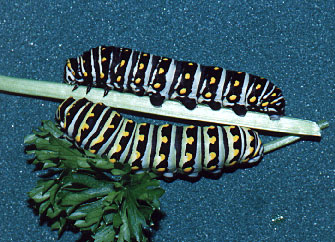 | |
| Two black swallowtail butterfly larvae. photo by Jacalyn Loyd Goetz | |
Bt 176 is not commonly grown in the U.S., accounting for less than 2% of the corn acreage, so experts suggest that insect populations in the U.S. are unlikely to suffer harm. Registration of Bt 176 will expire this fall, unless a request for renewal is filed, and no such request is expected.
Gene flow
The potential for the spread of genes from transgenic crops to nearby plants raises concerns on several fronts. Movement of pollen from a transgenic field to an organic field involves farmers in discussions about the distance required between fields to ensure purity of a crop and about who must pay if unwanted genes move into a neighbor’s crop. Hybridization of crops with weedy wild relatives may cause weeds to acquire traits we wish they didn’t have, such as resistance to herbicides. Research results (Science 293:1425-1426) presented at an ecology convention this past summer suggest that the effects of crop-to-weed gene flow merit consideration.
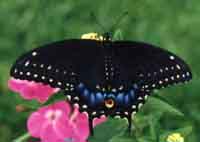 |
| Black swallowtail butterfly photo by Jacalyn Loyd Goetz |
While studies show that transgenic crop plants themselves are unlikely to persist in the wild without cultivation by humans, crop genes that escape to wild plants may persist for years in wild populations. A six-year study by Ohio State University professor Allison Snow found that crop genes from cultivated radishes escaped to wild, weedy radishes and persisted for generations. Genes that provide a competitive edge, such as resistance to viral disease, could benefit weed populations around a crop field. Wild oats are often handicapped by infection with barley yellow dwarf virus, but in greenhouse tests the weedy wild oats grew better than crop oats when both were disease-free, according to Cornell University professor Alison Power.
The movement of genes depends on several factors, including the pollination strategy of the crop, the presence of compatible crop plants or wild relatives in the area, and the overlap of flowering times. The likelihood that transgenes will spread can be different for each crop in each area of the world. Self-pollinating plants, such as soybeans and wheat, are less likely to spread their transgenes than cross-pollinating plants such as corn and beets. Transgenic soybeans grown in the U.S. and transgenic maize grown in Europe have no relatives nearby, while transgenic soybeans in Asia and transgenic maize in Mexico are likely to be able to hybridize with local plants that flower at the same time as the crop.
See the chart, developed from several published sources, provides a review of cultivated crops that are known to hybridize with wild relatives in various areas of the world is available at
New transgenic crops will need to be evaluated on a case-by-case basis with respect to the potential for crop-to-weed gene flow for each species in each geographic location.
A discussion of gene flow from transgenic plants is
available on pages 80-93 of Genetically Modified Pest-protected Plants,
published in 2001 by the National Academy Press.
| Crop Species |
Pollination |
Area where grown |
Compatible Relatives |
| alfalfa Medicago sativa |
mostly cross-pollinated |
USA |
wild alfalfa Medicago sativa |
| asparagus Asparagus officinalis |
mostly cross-pollinated |
USA |
wild asparagus Asparagus officinalis |
| blueberry Vaccinium angustifolium |
mostly cross-pollinated |
USA |
wild blueberry Vaccinium angustifolium |
| burmuda grass Cynodon dactylon |
mostly cross-pollinated |
USA |
wild burmuda grass Cynodon dactylon |
| carrot Daucus carota |
mostly cross-pollinated |
USA |
wild carrot Daucus carota |
| celery Apium graveolens |
self- and |
USA |
wild celery Apium graveolens |
| chicory Chicorium intybus |
mostly cross-pollinated |
USA |
wild chicory Chicorium intybus |
| clover Trifolium spp. |
some cross-, some self-pollinated |
USA |
wild clover Trifolium spp. |
| corn Zea mays ssp. mays |
mostly cross-pollinated |
Mexico and Central America |
wild relatives of corn Zea mays ssp. mexicana Zea mays ssp. parviglumis Zea mays ssp. huehuetenangensis Zea diploperennis Zea perennis Zea luxurians |
| cranberry Vaccinium macrocarpon |
mostly cross-pollinated |
USA |
wild cranberry Vaccinium macrocarpon |
| foxtail millet Setaria italica |
mostly self-pollinated |
France |
green foxtail Setaria viridis |
| lettuce Lactuca sativa |
mostly self-pollinated |
USA |
wild lettuce Lactuca serriola |
| oats Avena sativa |
mostly self-pollinated |
USA |
wild oats Avena fatua |
| oilseed rape, canola Brassica napus |
mostly self-pollinated |
France USA |
wild radish Raphanus raphanistrum wild brassicas Brassica napus Brassica campestris Brassica juncea |
| quinoa Chenopodium quinoa |
mostly self-pollinated |
USA |
wild quinoa Chenopodium berlandieri |
| radish Raphanus sativus |
mostly cross-pollinated |
USA |
wild radish Rapahnus raphanistrum |
| rice Oryza sativa |
mostly self-pollinated |
USA |
red rice Oryza sativa |
| tobacco Nicotiana tabacum |
mostly self-pollinated |
USA |
tobacco escaped from
cultivation Nicotiana tabacum |
| sorghum Sorghum bicolor |
mostly self-pollinated |
USA |
Johnsongrass Sorghum halapense |
| squash Cucurbita pepo |
mostly cross-pollinated |
USA |
wild squash Cucurbita texana |
| strawberry Fragaria X ananassa |
self- and cross-pollinated |
USA |
wild strawberry Fragaria virginiana |
| sugar beets Beta vulgaris |
mostly cross-pollinated |
France |
wild beets Beta vulgaris |
| sunflower Helianthus annuus |
mostly cross-pollinated |
USA |
wild sunflower Helianthus annuus |
| walnut Juglans regia |
self- and cross-pollinated |
USA |
California walnut Juglans hindsii |
| wheat Triticum aestivum |
mostly self-pollinated |
USA |
jointed goatgrass Aegilops cylindrica |
Sources for table: Arriola and Elstrand, 1996. American Journal of Botany 83(9):1153-1160. Baranger et al., 1995. Theoretical and Applied Genetics 91:956-963. Desplanque et al., 1999. Theoretical and Applied Genetics 98:1194-1201. Doebley, 1990. BioScience 40(6):443-448. Klinger et al., 1992. American Journal of Botany 79(12):1431-1435. Saeglitz et al., 2000. Molecular Ecology 9:2035-2040. Snow and Palma, 1997. BioScience 47(2):86-96. BioScience 47(2):86-96. Till-Bottraud et al., 1992. Theoretical and Applied Genetics 83:940-946. Zemetra et al., 1998. Weed Science 46:313-317. |