
Doubts over 'pharming' technology
Some proteins can only be made in mammalian
cells Doubt has been cast on the potential for using genetically modified
animals as pharmaceutical factories.
It follows the announcement of a delay
of at least two years in the testing of the drug that was aiming to be
first "pharmed" product to market. Analysts said there were now serious
questions being asked about the future viability of the sector. The decision of PPL Therapeutics - the Scottish biotechnology company
that owns the technology behind Dolly the sheep clone - to push back the
commercial launch of AAT (alpha-1-antitrypsin) has prompted a crisis of
confidence in investors. The reason for the delay in the drug, designed to treat lung diseases,
was said to be due to patients "wheezing" in clinical trials. Necessary stage For more than a decade, it has been possible to make pharmaceutically
useful human proteins in genetically modified bacteria. Insulin, for
example, is now produced in vast quantities in this way. But some human proteins are either too large or too complex for
microbial cells to synthesize. PPL has the patent on technology that will
drive the production of human proteins in the milk of sheep and other farm
animals. And allied to cloning, this should allow PPL to set up whole flocks
that can be pharmed for human proteins in an economically viable way. PPL currently has a number of transgenic sheep producing alpha-1-antitrypsin,
a protein which sufferers of several lung diseases - notably hereditary
emphysema and cystic fibrosis - lack. A drug made from this sheep-produced
human protein is now in clinical trials, a process that must be completed
to satisfy regulators the product is both safe and effective. But PPL has said it will now have to conduct further investigations
before it can take the drug into the final stage of the trials. This means
AAT is unlikely to reach the market before 2007, two years later than
expected. Patients drop out The setback is the latest in a series of problems for PPL. Julie
Simmonds, an analyst at Beeson Gregory, said: "PPL are going backwards
rather than forwards. My concern is that there is a fundamental problem
with the technology." PPL's chief executive Geoff Cook said: "It is certainly a
disappointment. But the most important thing to make sure of is that when
we do go into the next phase of trials, we go with absolute belt and
braces security. "The regulators are extremely stringent, because this could be the
first drug from transgenic animals to reach the market." Last year, the US Food and Drug Administration told PPL that it had
concerns about three patients who failed to complete a phase II trial of
AAT. Mr Cook said he understood they had dropped out because they suffered
"extra wheezing", exacerbating a condition that is common in emphysema.
PPL said it could be linked to the dosage or purity of the drug, or to an
inhaler supplied by a partner company. But initial analysis has failed to pin down the problems with certainty
and now further investigations will be undertaken. Growing doubts Biotechnology analysts say there are now growing doubts about whether
transgenic technology can work. One of PPL's rivals, Dutch firm Pharming, went bust last year. Also,
progress in work on transgenic animals by Genzyme in the US has been slow.
Analyst Julie Simmonds told BBC News Online: "My main concerns are
around the fact that to date no transgenic products have reached the
market - although quite a number have been in development for some time.
"This may just be the natural rate of attrition of pharma products -
however, one would expect that proteins should be easier to develop,
although final delivery to the patient may be more of a problem." Sally Bennett, of ING Barings, said: "This is pretty significant bad
news - they've had delay after delay. There have been doubts growing about
the viability of transgenic animals for some time." 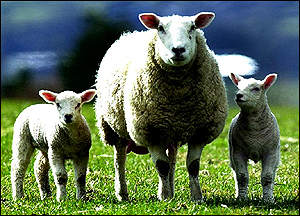

By Dr David Whitehouse
BBC News Online science editor


Election-year fight for control of Congress spurs farm-bill push
By Sue Kirchhoff, Globe Staff,
4/2/2002
WASHINGTON
- Political control of Congress is directly tied to the size of federal farm
subsidy checks.
That simple fact explains why both
parties are fighting so hard to pass a new farm bill edging the government
away from a brief, free-market experiment in agriculture and back toward
guaranteed subsidies rooted in the Dust Bowl and Great Depression of the
1930s.
While only about 2 percent of
Americans live on farms, some of this year's most endangered Senate
Democrats hail from states that would gain from the whopping $73.5 billion
increase in farm aid Congress is considering - South Dakota, Iowa, Minnesota,
Montana, and Missouri. Since Democrats control the Senate 50-49, with one
independent, James Jeffords of Vermont, any of those contests could tilt the
balance.
''They have to get something
for the agriculture community,'' said Jennifer Duffy, who tracks Senate
races for the Cook Political Report.
Failure to get a bill could hurt
incumbents such as Iowa Democrat Tom Harkin, chairman of the Senate
Agriculture Committee. Harkin is under attack from Republican Representative
Greg Ganske. Ganske, a doctor, is himself in a primary battle against a
farmer.
''If nothing comes out of this,
that's a huge downside because then you could start talking about Democratic
gridlock. It takes on that bigger partisanship issue,'' Duffy said
But there are pressures on both parties. President Bush initially opposed
lawmakers' calls for the $73.5 billion, 10-year increase in spending. He
relented not only to help candidates, but to secure crucial votes for his
$1.35 trillion tax cut and a bill giving the White House more power to
negotiate international trade deals.
Then there is the personal element. The White House is doing all it can to
defeat South Dakota Democratic Senator Tim Johnson - a close ally of Senate
Democratic leader, and fellow South Dakotan, Tom Daschle. Bush personally
recruited GOP Representative John Thune - whose campaign Web site is
decorated with grain stalks - in the most bitterly fought race in the
country.
''It's an incredibly contentious race of great attention virtually more of a
battle between Bush and Daschle,'' said Brad Redlin of the Center for Rural
Affairs in Walt Hill, Neb. ''Farm issues are primary.''
The agriculture debate didn't arise because of the election; Congress
rewrites farm policy every five years. But the political stakes give it far
more punch.
In 1996 a divided Congress voted to ''deregulate'' farming by ratcheting
down subsides and moving farmers toward export markets. Then prices tanked.
Five years, four emergency bills and $30 billion in disaster payments later,
both parties are focused on a more traditional policy of guaranteed aid,
though without the rigid planting controls of past years.
The House and Senate are thrashing out a $170 billion 10-year scheme that
could deliver higher payments to milk producers in 12 northeastern states.
Conservation funding would rise 80 percent, helping preserve green space in
New England.
Still, the bulk of funding will go to producers of crops like corn, cotton,
and wheat who will see crop subsidies rise dramatically.
Peanut producers who for decades have operated under a ''temporary'' quota
system would get a new loan program - and the government would pony up more
than $1 billion to compensate current quota holders. (Boston-based John
Hancock Financial Services is one of the nation's largest peanut quota
holders.)
Critics say such policies have led to a vicious circle of overproduction,
inflated land values, and low prices. Most subsidies go to big producers,
rather than small, family farms.
''The momentum is to do business as usual and provide the biggest part of
the funding to the biggest operators who've been getting it all along,''
said Ken Cook of the Environmental Working Group.
His group has posted federal data detailing how much money individual
farmers get from the government - a move that caused consternation in farm
country. From 1996 to 2001, 10 percent of recipients got 69 percent of all
subsidies.
Farm programs are politically and economically entrenched in areas like the
Great Plains, which gets more federal aid per capita than any other part of
the country. Public attention was focused on Congress's recent economic
stimulus package, but agriculture supports are far more vital in some
regions.
''I have never had as many phone calls from lenders saying we're not lending
because [growers] don't have cash flow without farm payments,'' said Mary
Kay Thatcher, lobbyist for the American Farm Bureau Federation.
Given the dwindling federal budget surplus, banks are no longer confident
Congress will continue to step in with annual emergency aid, if negotiations
on a long-term bill fail.
Lawmakers argue that subsidies stabilize an industry that faces volatile
weather, unpredictable markets, and has been in a multiyear recession.
Prices for some crops such as soybeans and cotton have fallen to 30-year
lows since the 1996 farm bill, while farmers have also been hurt by bad
weather. Without federal aid, farm income would have been at the lowest
levels since the farm crisis of the mid-1980s.
''All I hear is disaster assistance. Montanans need disaster assistance,''
said Democratic Senator Max Baucus - a prime target of Republicans - whose
state has suffered from prolonged drought.
There is agreement on the general direction of the bill, but deep divisions
on specifics. The Senate wants to slap a $275,000 per-farm cap on subsidies
- a lower ceiling than the House wants. That has provoked a regional fight.
Midwest grain farmers wouldn't take too big a hit, but southern producers of
crops like cotton and rice, which have higher production costs, would.
Another divisive Senate proposal, sponsored by South Dakota's Johnson, would
limit livestock ownership by the meatpacking industry. Many small ranchers
complain packers have near-monopoly control.
Virginia-based Smithfield Foods, the nation's largest meat processor has run
full-page newspaper ads against the plan, threatening to shut down a South
Dakota plant that provides 3,200 jobs. Another 3,000 associated jobs could
be lost.
''The farm bill is a big deal in South Dakota. Our economy has been
diversified a lot in recent years, but agriculture is still the issue that
drives [it],'' said Johnson.
Thune, has sponsored a less sweeping version of the packing restrictions.
''The Senate has kind of lagged behind. I don't know exactly where the
leadership of the Senate is right now'' on some key issues, said Thune chief
of staff Jafar Karim.
Bush has been stumping in farm country as he tries to help Republicans win
the Senate.
He traveled to Aurora, Mo., in January to talk agriculture and appear with
Republican James Talent, who is challenging Democratic Senator Jean Carnahan.
Bush will travel to Iowa next month to stump for Ganske in his race against
Harkin.
Harkin is torn between competing constituencies and has been forced to
retrench due to a $6.1 billion accounting error by the Congressional Budget
Office that put his bill over budget. Though the mistake wasn't his fault,
he didn't help himself by saying it amounted to little more than ''pencil
dust'' in the overall budget.
''You know what, $6.1 billion is more than the entire state of Iowa budget,''
Ganske said.
| News Topics | ||


Previous Notes |
|
| Read | |
 |
 |
|
