
 Better
Agriculture Advances Fight against
Global
Warming New Crops and Better
Management Techniques Counteract
Effects
of Climate Change
Better
Agriculture Advances Fight against
Global
Warming New Crops and Better
Management Techniques Counteract
Effects
of Climate Change
Farmers in developing countries are helping nature store away vast amounts of atmospheric carbon by growing high-yielding, land-efficient food crops that save room for forests, according to a report recently released by the 16 Future Harvest research centers.
The report puts the amount of land saved over the past 30 years at 426 million hectares or nearly 1.0 billion acres. The savings are helping nature to store atmospheric carbon equal to a third of the amount released annually by all sources in the United States.
"By planting high-yielding varieties, farmers have left untouched vast areas of land that would have otherwise been needed to grow food," says Pedro Sanchez, director general of the Kenya-based International Centre for Research in Agroforestry (ICRAF).
Sanchez, who is also a member of the United Nations Intergovernmental Panel on Climate Change (IPCC), notes that researchers are optimistic that agriculture can do even more to benefit the climate in the future.
Carbon Swaps and Farmers
The most recent IPCC report states that farmers should be able to trap large amounts of atmospheric carbon by improving the management of crop and cattle grazing areas. A case in point, Sanchez says, are deep-rooted pasture grasses imported from Africa to rehabilitate degraded pasture in South America. The new grasses trap huge amounts of carbon in the subsoil.
"We could trap nearly 700 million tons of additional carbon each year if only 10 percent of the farmers would adopt up to four practices," Sanchez says. "That's about a tenth of the carbon that enters the atmosphere each year from all sources." The new practices include agroforestry, the use of conservation tillage on existing cropland, improved management of animal grazing areas, and the use of reduced-impact forest harvesting techniques.
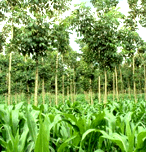
Farmers are likely to make their greatest impact on reducing greenhouse gasses, Sanchez says, with agroforestry, or planting trees on farms. According to the IPCC report, converting one hectare of unproductive cropland or grassland to agroforestry can trap more than 3 tons of carbon per hectare (2.4 acres), the equivalent of driving three large automobiles a distance of 10,000 mile (16,000 kilometers) in a year.
"Agroforestry can help farmers move from systems that rely on the burning of forests to ones that are more permanent and more productive," Sanchez adds.
Sanchez and other IPCC members suggest that agroforestry, as well as other improved methods for managing crop and grazing land, be included as options for the Clean Development Mechanism of the Kyoto Global Warming Protocol. The Clean Development Mechanism is a legal instrument to help industrialized countries meet their target for reducing emissions of greenhouse gasses.
"The fact that you can use farms to store carbon provides poor people with new options for increasing their incomes, either by entering the cash economy or by participating in so-called carbon swaps," Sanchez says.
In a carbon swap arrangement, industrialized countries would be allowed to meet their commitments under the Kyoto Protocol by investing in projects that trap greenhouse gasses in developing countries. But Sanchez cautions that most carbon swap projects do not involve farmers or do not provide them with sufficient economic incentives to become involved.
A new study on carbon swapping schemes, however, suggests that the success of carbon swaps projects would be greatly improved if local communities were involved in their design and management. The report was prepared by the Indonesia-based Center for International Forestry Research (CIFOR) and the University of Maryland. The report finds that carbon swaps that incorporate agricultural options into forestry projects provide greater benefits to local communities.
Jeffery Sayer, CIFOR's director general, notes that there are numerous technical issues involved in designing carbon swap programs but that scientists have made significant advances in how to execute them in a number of countries.
Coping with Changing Climate
Climate change experts including Robert Watson—chairman of the IPCC and the World Bank's chief scientist—say that advances in agricultural science should be coupled with research to mitigate climate change and adapt to its effects. In an agricultural meeting last month, Watson predicted that global temperatures will rise 3 to 6 degrees centigrade over the next 100 years. According to Watson, even small changes in temperature and rainfall could greatly affect both agricultural land and forests and lead to a dramatic decline in farm productivity.
"Over the past decade a great deal of research has been conducted that can benefit both farmers and the environment," Sanchez says. "But intensifying production to a level where farmers will not have to bring new land into production will be a major challenge."
The 16 Future Harvest centers recently approved a three-year, $20 million pilot program for research associated with reducing global warming. One of the program's major priorities will be to develop rice varieties and water management practices that can reduce the emission of methane, one of the major greenhouse gasses.
Other priorities include the development of crop varieties that are more heat resistant, can tolerate greater disease and insect pressure, or withstand exposure to excess water.
Improving the efficiency of nitrogen fertilizers, a major source of nitrous oxide emissions, will also receive scrutiny, as will the development of simple and accurate ways to measure soil carbon.
A major provision of the program, according to Sayer, involves training government officials from the G-77 group of developing countries, starting with the nations of Sub-Saharan Africa.
Unless politicians and government officials grasp the essential elements of the science, it will be difficult for them to develop adequate public policies. "Our goal is to help develop a more knowledgeable cadre of government representatives that not only understands the science but can communicate it to their constituents. The long-term objective is not only to ensure that we can tackle technical problems but that everyone comes to the table equipped to make the hard decisions and to negotiate," Sayer says.
The first training programs are scheduled to begin in Nairobi by June 2001.
###
For more information contact ICRAF at d.lodoen@cgiar.org or CIFOR at m.hailu@cgiar.org.
For the report Capturing the Value of Forest Carbon for Local Livelihoods, visit www.cifor.org/news/carbon.htm.
For the IPCC Special Report Land Use, Land Use Change, and Forestry, visit http://www.ipcc.ch/.
The Center for International Forestry Research (CIFOR) is a global knowledge organization committed to enhancing the benefits of forests for people in the tropics. CIFOR was established to address global concerns about the social, environmental, and economic consequences of loss and degradation of forests. It operates through a series of highly decentralized partnerships with institutions and individuals throughout the developing and industrialized worlds. CIFOR is a Future Harvest Center supported by the Consultative Group on International Agricultural Research (CGIAR) http://www.cifor.org/
The International Centre for Research in Agroforestry (ICRAF) is a nonprofit institution that conducts innovative research and development in agroforestry, strengthens the capacity of its partners, enhances worldwide recognition of the human and environmental benefits of agroforestry and management. ICRAF does this by combining the best of science with farmer knowledge in a wide range of strategic alliances across the research-development continuum. ICRAF is a Future Harvest Center supported by the CGIAR. www.cgiar.org/icraf
Future Harvest is a nonprofit organization that builds awareness and support for food and environmental research for a world with less poverty, a healthier human family, well-nourished children, and a better environment. Future Harvest supports research, promotes partnerships, and sponsors projects that bring the results of research to rural communities, farmers, and families in Africa, Latin America, and Asia. Future Harvest is an initiative of 16 food and environmental research centers supported through the CGIAR. http://www.futureharvest.org/
| News Topics | ||


Previous Notes |
|
| Read | |
 |
 |
|
