
|
Wastewater Irrigation: Economic Necessity or Threat to Health and Environment? In Developing Countries the Choice Is Often Wastewater or No Water |
||
|
In the old colonial city
of Guanajuato, Mexico, local officials are constantly on the lookout for
new ways to cope with the city's swelling sewage problem. Located 370
kilometers northwest of Mexico City, Guanajuato's population growth and
an influx of international visitors have outpaced the capacity of its
sewer system, parts of which date back to the seventeenth century.
Taking their cues from industrialized countries and Mexican environmental law, Guanajuato officials are now considering a proposal to build a multi-million dollar waste treatment plant, a project that some observers feel they cannot afford. "Building wastewater treatment plants may seem like a good investment, but in the end may not be the best way to solve the problem, says Chris Scott, a hydrologist working with the International Water Management Institute, IWMI. The estimated price of the Guanajuato plant, Scott notes, is US$2.6 million with an annual operating cost of US$200,000. A better alternative, he suggests, would be to apply Guanajuato's sewage to farmers' fields downstream from the city in a way that does not endanger health or the environment. "In many cases, irrigating fields with wastewater can serve as a de facto treatment facility and also save poor farmers the cost of buying fertilizer," Scott says. Irrigating With Sewage "The objective of our research is to identify the conditions under which wastewater can be used for irrigating and fertilizing crops without putting people or the environment at risk," says Frank Rijsberman, IWMI's director general. "We know, for example, that in many places wastewater can be applied to grain and pasture crops with little or no impact on public health." "It wasn't so long ago," he adds, "that farmers in Europe and the United States irrigated their crops with raw sewage, but that was at a time when populations were smaller and before commercial fertilizers were widely available." "Over the past several years, our researchers have been working to uncover the facts about wastewater irrigation so that developing countries can make informed decisions," Rijsberman says. He notes that a recently completed study in Pakistan confirms that wastewater irrigation also offers substantial benefits to farmers who grow high-value crops such as fruits and vegetables. The downside, Rijsberman notes, is that under local conditions, the practice can contaminate the soil with heavy metals. The main public health concern, however, is infection from intestinal nematodes and bacteria, especially those that cause cholera. IWMI researchers are also studying ways to manage irrigation ponds to reduce their role as incubators for mosquitoes and snails that carry disease. "The truth is in the details," Rijsberman says. "Using wastewater in one location may be relatively safe, while in another it can have disastrous consequences. If people have no other options, they will use wastewater whether or not their governments approve. Our job is to provide a clear understanding of the situation so that local officials know where the practice is safe." Rijsberman notes that weather and local soil conditions often help to determine where wastewater can be safely applied. Research in India, for example, shows that raw sewage actually improved soil structure and increased nutrient level without a significant buildup of heavy metals. In contrast, the sandy soils found in the Middle East are often unable to absorb wastewater nutrients and contaminants. Researchers are particularly concerned, he says, about use of the practice in the Nile River delta, where the Egyptian government is attempting to reclaim desert land using wastewater from Cairo. "We don't necessarily encourage the use of wastewater," Rijsberman adds. "We simply want to point out that it can offer an alternative under certain conditions. Our research helps to determine where and when the practice is safe and what steps are needed to manage it over the long-term." Rijsberman notes that the use of wastewater to fertilize and irrigate crops is on the increase. "The question we have to ask ourselves," he says, "is whether we are going try to use wastewater as a manageable resource or simply ignore it and hope for the best." 22 March 2001 ### For more information contact: m.devlin@cgiar.org. The International Water Management Institute is a scientific research organization working to improve water and land resources management for food, livelihoods, and nature. IWMI works with partners in developing countries to develop tools and methods to help eradicate poverty through more effective management of water and land resources. IWMI's work brings together hydrologists, agronomists, economists, social scientists, environmental researchers and health experts on multidisciplinary research projects. It is the only organization of its kind that is fully dedicated to providing the scientific basis necessary to help developing countries reduce poverty through more effective management of their water and land resources. http://www.iwmi.org/ Future Harvest is a nonprofit organization that builds awareness and support for food and environmental research for a world with less poverty, a healthier human family, well-nourished children, and a better environment. Future Harvest supports research, promotes partnerships, and sponsors projects that bring the results of research to rural communities, farmers, and families in Africa, Latin America, and Asia. Future Harvest is an initiative of the 16 food and environmental research centers that are primarily funded through the Consultative Group on International Agricultural Research. http://www.futureharvest.org/ |
|
 Wastewater irrigation, Pakistan
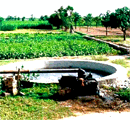
Domestic use of irrigation water, Pakistan
Guanajuato irrigation
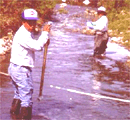
Harvesting watercress, Vietnam
Wastewater irrigation, Pakistan
|
|
|
||


| News Topics | ||


Previous Notes |
|
| Read | |
 |
 |
|
