
|
Research Gives Birth to Nigerian Soybean Industry Tofu Fights Hunger and Earns Cash for Women Farmers and Entrepreneurs |
||
|
Ask any farmer in central Nigeria which local food crop is good for her
children, puts cash in her pocket, and enriches the soil, and she'll
probably say "soybean." Then ask her how she prepares it, and she'll
likely say "as tofu."
In little more than two decades, Nigeria — Africa's most populous country — has become the continent's largest producer of soybeans and soy products. While still a relatively minor player in a US$40 billion global market, Nigeria has been quick to profit from new technology that has helped farmers overcome a series of complex production problems. Last year, Nigerian soybean producers harvested an estimated 500,000 tons of the small, light-brown beans, a 20-fold increase in just over 20 years. The harvest, which was valued at US$ 85 million, was used to produce a variety of traditional dishes, as well as processed foods such as soymilk and specially formulated foods to help malnourished infants and children. A Near-Perfect Crop "Soybeans are a near-perfect crop for a country like Nigeria," says Lukas Brader, director general of the International Institute of Tropical Agriculture, IITA, one of the 16 Future Harvest centers. "Nutritionally, they carry twice the protein of meat or poultry and contain all eight essential amino acids needed for childhood development." Soybeans are also good for the environment, Brader says. Because they evolved in Asia, they are far less vulnerable to local insects than African bean crops and require fewer insecticide sprays. They also fix atmospheric nitrogen, which reduces the need for farmers to purchase fertilizer. Best of all, they are affordable. In Nigerian markets, soybeans cost about one-fifth as much as other forms of protein, including dairy and fish and are easier to store and transport. "Those are big advantages for a crop," Brader says. " But to get to that stage, our researchers had to produce an entirely new plant type that could cope with high disease pressure, compete with parasitic weeds, and grow in African soils." "Basically, our plant breeders had to redesign the crop," he says. IITA soybeans, he notes, are two to three times more productive under Nigerian conditions than U.S. and Asian varieties. Funding for the research, some US$20 million, was provided by the members of the Consultative Group on International Agricultural Research (CGIAR), building on seed money provided by Canada's International Development Research Centre (IDRC). My Second Husband "Soybean has been a godsend for Nigeria," says Professor Dele Fakorede, an agricultural expert based at Nigeria's Obafemi Awolowo University. "Our farmers are earning good money, our small industries are prospering, and our children and young mothers are benefiting from a locally-made, protein-rich food." Nigerian women would seem to agree. In Benue State, a major soybean producing area in the central part of the country, women farmers often describe the crop as their "second husband" because it helps to pay school fees and medical bills. "Soybeans are making it possible for a lot of women to earn their own way and achieve a greater degree of independence than ever before," says Fakorede. While the new plant types have made it possible to expand soybean farming across large parts of the country, most observers agree that what sparked production was the development of soy-based food products, including a West African version of tofu. It was a Japanese researcher, Osamu Nakayama, who got the idea to use tofu as a substitute for wara, a traditional but expensive kind of local cheese, says Brader. "And, of course, there were skeptics." "A lot of people had doubts that we would succeed or that tofu would ever be accepted by Nigerian consumers," Nakayama says, "but eventually we succeeded in making a good wara substitute using soymilk and local plant extracts. Nakayama worked at IITA as part of a scientific exchange program sponsored by the Japan International Cooperation Agency (JICA). The idea, Nakayama says, came from watching what local village women did to prepare food for their families. "We learned a lot through simple observation and by asking questions about traditional methods, he says. Nakayama's "wara-tofu" is similar in appearance to farmers' cheese or firm yogurt and has a taste and texture that is only slightly different from Asian-style tofu. Local cooks say that it is easily incorporated into traditional recipes and costs about a third as much as wara made from cow's milk. Today, the demand for tofu and other processed soy foods is growing at an annual rate of 20 percent, fueling a major cottage industry in rural Nigeria. A follow-up report by researchers at Nigeria's University of Ibadan points out that children who grow up in soybean-producing communities are generally healthier and suffer less malnutrition than the average Nigerian child. Improved nutrition, researchers believe, also helps to limit the spread of HIV/AIDS. In the places where soybeans are grown, roughly 40 percent of the income earned by women is thought to be derived from soybean production or processing. Thus far, nearly 100,000 Nigerians, three-fifths of them women, have been trained in soybean production and in the preparation of soy products by local NGOs, hospitals, and church groups working in cooperation with IITA and various government agencies. "The private sector is also becoming a major player in the market for soybean and soy products," says Brader. Nigeria now has more than 65 soybean processing plants, ranging in size from small village-level mills to large plants established by food processing giants Nestle and Cadbury. The big processors, he notes, use soybean to boost the protein content of baked goods, breakfast cereals, weaning foods, and dairy products. Currently, about 140 soy-based food products have been developed for use in Nigeria. "Nigeria's experience with soybean shows that everybody wins in a global economy when science and technology is allowed to cross international borders," Fakorede says. "We are grateful for the opportunity to grow a crop that originated in Asia, and we look forward to the day when we can begin trading soybeans with our Asian brothers and sisters." At current rates of growth, and with new varieties moving through the research pipeline, it may not be long before Nigeria becomes a more significant player in the international soybean market, Fakorede adds. 9 April 2001 ### For additional information about the Nigerian soybean program , contact r.eaglesfield@cgiar.org The International Institute of Tropical Agriculture (IITA) (www.cgiar.org/iita), with headquarters in Ibadan, Nigeria, works to develop sustainable food production systems in tropical Africa and is recognized for its expertise in biological control. IITA is one of 16 Future Harvest Centers and receives funding through the Consultative Group of International Agricultural Research (CGIAR), a consortium of more than 58 governments, foundations, and international and regional organizations Future Harvest is a non-profit organization that builds awareness and support for food and environmental research for a world with less poverty, a healthier human family, well-nourished children, and a better environment. Future Harvest supports research, promotes partnerships, and sponsors projects that bring the results of research to rural communities, farmers, and families in Africa, Latin America, and Asia. Future Harvest is an initiative of 16 food and environmental research centers that receive funding from the CGIAR. (http://www.futureharvest.org/) |
|
 Tofu: A New Ingredient in Traditional Food
Soybeans in Field
Soymilk for Infants
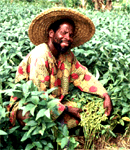
Soybeans Generate Income for Nigerian Women
Researcher and Soybeans
|
|
|
||


| News Topics | ||


Previous Notes |
|
| Read | |
 |
 |
|
