
|
From Clients to Partners
|
|||||
|
By the
1980s new agricultural technology, based on scientific research, had
taken hold across much of Latin America. Improved varieties and better
crop husbandry brought about substantial production gains,
particularly in two major staples, rice and wheat. But at many
locations, notably in the more isolated and difficult environments,
farmers proved reluctant to adopt new varieties of staple crops or
even rejected them outright.
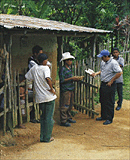
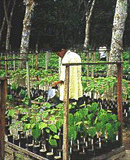
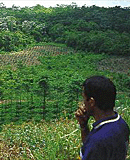
Some scientists argued that low adoption of new technology was the result of a mismatch between the products available and the varied preferences and circumstances of rural people living in marginal areas. This problem, in turn, stemmed from limited consultation between scientists and farmers. To bridge the gap between these two key actors in agriculture, a novel set of research methods, collectively known as participatory plant breeding (PPB), was created. The central ingredient of PPB is its systematic inclusion of farmers' knowledge, skills, and preferences in the development of new varieties. Instead of having only occasional contact, farmers and researchers work side by side to develop a more acceptable product. Like conventional breeding, PPB relies on the well-known scientific disciplines. But with the aid of social scientists, it involves farmers in key activities, such as setting breeding priorities, selecting from among variable populations, and evaluating varieties while they are still at the experimental stage. Scores of examples from all over Latin America show how national and international organizations have used PPB to shape new varieties of staple crops more closely to farmers’ preferences. Adding to the plant breeders' worries, scientists working in the vulnerable and difficult areas of Latin America became increasingly concerned during the 1980s about environmental damage resulting from agriculture. Among the chief consequences are excessive pesticide use, deforestation, biodiversity loss, and soil degradation, including serious erosion of topsoil. During recent decades many new technologies have been developed to address these problems. Soil scientists, to take one example, have worked extensively with measures such as the use of grass strips, cover crops, live fences, and a host of innovative tree-crop combinations. Nonetheless, in the marginal environments where such practices seem most necessary, adoption has been low. One key problem is that most new soil conservation methods were designed by researchers on experiment stations, or sometimes in farmers' fields, but with only token farmer participation. To remedy this situation, scientists focusing on environmental degradation in agriculture took a closer look at the new approach some plant breeders had chosen. They began developing participatory methods to incorporate farmers' perspectives into their research on natural resource management. Throughout this book you will find examples of how this novel approach to agricultural research and development has spread. Many researchers and farmers alike now regard it as the "natural" way to operate, with both traditional knowledge and formal science making a contribution. But it is important to keep in mind that each partner needs the other. While age-old practices still offer much to the search for sustainable agriculture, they are obviously no longer enough in many places. Population pressure and the need for progress in life demand more than traditional methods can provide. So renewal must also come from outside rural communities, with researchers making key contributions. Research results without application, on the other hand, make for a bad business that satisfies no one. This is why researchers have found it most simulating to get out of their laboratories, discuss their findings with users, and return with new ideas about how to move ahead. This participatory trend in agricultural research is entirely consistent with current directions in development assistance, where the catchwords these days are "ownership" and "partnership." Agricultural research organizations in developing countries have probably moved earlier, faster, and more concretely than most other institutions on the development scene. The information for the above text was compiled by Nathan Russell of CIAT, a Future Harvest Center of the Consultative Group on International Agricultural Research (CGIAR), and edited with the author of From the Rural Heart of Latin America. |
From the Rural Heart of Latin America
|
||||

.gif)

| News Topics | ||


Previous Notes |
|
 |
 |
|
