|
Johannesburg, South Africa, 28
August 2002
(Future
Harvest/IUCN)
Practical, real-world
solutions to food production and biodiversity conservation can feed
the world's poor today and satisfy the projected 40-60% increases in
global food demand over the next few decades, states the study
sponsored by Future Harvest and IUCN — The World Conservation Union,
released today.
The new book,
entitled "Ecoagriculture: Strategies to Feed the World and Save
Biodiversity", documents 36 case studies around the world to
demonstrate that reconciliation of interests between agriculture and
conservation is possible.
"This book is
more than just an academic study. Against a backdrop of the threat of
famine here in Southern Africa, it calls for world-wide action to
tackle the food crisis and to halt biodiversity loss, and provides
ground-breaking evidence of how that can be accomplished through an
integrated strategy," said Jeffrey McNeely, IUCN Chief Scientist
and co-author of the book.
Agriculture has
long been considered a leading threat to wild biodiversity, because of
its seemingly insatiable appetitite for land and water. Agricultural
expansion has been the principal cause of global habitat loss,
including over half of ecologically high-value wetlands. Almost half
of the 17,000 major protected areas devoted to biodiversity
conservation have at least 30% of their land used for agriculture.
Intensive farming is a major source of water pollution from
agrochemicals and livestock waste.
Yet increasing
agricultural production is essential. By mid-century human population
is projected to grow from 6 to 9 million, mostly in the low-income,
tropics and sub-tropics of the developing world. Total food production
today would be adequate to meet global needs, if equally distributed.
But surpluses in the developed world are not available to poor people
in the developing world, 75% of whom reside in rural areas. For most
of these people, farming is the principal livelihood. Indeed, more
than 1 billion people live today in and around biodiversity-rich "hotspots";
in most, massive poverty and food insecurity are also widespread.
Thus an
essential strategy for conserving wild biodiversity, especially that
found in highly populated, poor rural areas around the world, is to
convert agriculture that is destructive of biodiversity into a new
type of agriculture: 'ecoagriculture'. Ecoagriculture, which builds on
the concept of ecosystem management, refers to land-use systems that
are managed both to produce food and to protect wildlife and
critical ecosystem services.
"With
ecoagriculture, enhancing rural livelihoods through more productive
and profitable farming systems becomes a core strategy for both
agricultural development and conservation of biodiversity",
explains co-author Sara J. Scherr, Senior Policy Analyst of Forest
Trends and Advisor to Future Harvest.
The study
identified three dozen successful cases where innovations both
increased farm productivity and farmer incomes, and improved the state
of biodiversity. These cases resulted from experimentation by farmers,
conservationists and agricultural researchers in diverse farming
regions, and including both small and large-scale producers.
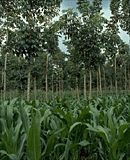
For example, in
eastern Zambia, 3000 farmers are using 'improved fallows' in which
fast-growing trees or shrubs are planted in fields left to rest after
cropping. Developed through on-farm research, these fallows increase
farm productivity and food security by improving soil organic matter
and nutrients, and reduce the need for expensive fertilizers. Farmers'
annual income from maize has nearly tripled, and wood from the trees
is used for poles and fuel. Meanwhile, wildlife can use the fallow
plots for habitat and refuge.
Another example
of ecoagriculture is found in a mountain region of Costa Rica, where
farmers in 19 communities have planted 150 hectares of tree windbreaks.
These windbreaks, linking remnant forest patches with important
protected areas, function as a 'biological corridor' through which
species can migrate. The windbreaks also protect dairy cows and coffee
fields from damaging winds and wild parakeets, thus increasing milk
and coffee production.
The book was
launched at the IUCN Environment Centre in Johannesburg, during the
first week of the World Summit on Sustainable Development. Agriculture
and Biodiversity are two of the five priority areas for action at the
Summit, identified by the UN Secretary General Kofi Annan.
Published by
Island Press, the book can be ordered online at
http://www.islandpress.org/.
Authors: Sara J.
Scherr, Future Harvest,
sjscherr@aol.com
Jeffrey A. McNeely, IUCN — The World Conservation Union,
jam@hq.iucn.org
***
Future Harvest
is a foundation dedicated to building awareness of global public
issues that are related to food security, health, poverty reduction,
and the environment. Future Harvest is an initiative of the 16 Future
Harvest research centres supported by the Consultative Group on
International Agricultural Research (CGIAR).
The Consultative
Group on International Agricultural Research (CGIAR) is a strategic
alliance of 58-members and sixteen Future Harvest Centers that
mobilizes cutting-edge science to promote sustainable development by
reducing hunger and poverty, improving human nutrition and health, and
protecting the environment.
http://www.cgiar.org/
IUCN - The World
Conservation Union brings together 79 states, 113 government agencies,
754 NGOs, 36 affiliates, and some 10,000 scientists and experts from
181 countries in a unique worldwide partnership. IUCN's mission is to
influence, encourage and assist societies throughout the world to con-serve
the integrity and diversity of nature and to ensure that any use of
natural resources is equitable and ecologically sustainable.
|