
Should
Use Of Genetically Modified Organisms Be Labeled?
Julie A. Caswell
University of
Massachusetts - Amherst
Consumers are increasingly considering information on how foods are produced in making their buying decisions leading producers, processors, and retailers to do the same. Federal and state governments, as well as international standards organizations, face a dilemma in designing labeling programs for process attributes such as use of biotechnology. On the one hand, labeling is appropriate for process attributes that consumers care about and may be willing to pay more to get or avoid. On the other hand, regulators may be reluctant to label these attributes because they believe the labeling will be taken as an indicator of final, consumer-level safety in cases where it is not. In addition, labeling of process attributes may impose significant costs on an industry's supply chain related to segregating products and verification.
Policy Options
The choice of labeling policy will be important in the development of markets for foods produced with the use of biotechnology, and specifically, with the use of genetically modified organisms (GMOs). To address the question of whether use of GMOs should be labeled we must first define what we mean by labeling. The main policy options for government are:
- Allow no labeling regarding the use or nonuse of GMOs.
- Require mandatory labeling of products that use GMOs.
- Allow voluntary labeling of products that do or do not use GMOs.
- Allow voluntary labeling of products that do not use GMOs, with an accompanying disclaimer noting the government's judgement about any differences (e.g., safety) between products that use and do not use GMOs.
The options have markedly different implications for market development. Under the first option, no differentiation is possible based on use or nonuse of GMOs. This approach may be viewed as desirable by proponents of the new technology because under it use of GMOs is treated as no
different from use of existing technologies. However, this approach has the drawback of suggesting that regulators and producers who use the technology are afraid of consumer sovereignty and want to suppress other producers' ability to differentiate products based on nonuse of the technology.
From a regulator's point of view, the second option of mandatory labeling of use of GMOs has the advantage of giving consumers full information. On the other hand, if there are no real differences between products that use or do not use the technology, the label may not be useful to consumers or could actually be deceptive and may unnecessarily impede adoption of the technology. Further, labeling is not costless since it requires segregation of product and verification. Users of GMOs also tend to oppose mandatory labeling because they believe it will hurt market acceptance. Whether this is the case depends on the market; companies have not really explored the possibility of marketing use of GMOs as a positive attribute (e.g., promoting a product's advantages due to use of new technology).
The third option of voluntary labeling has the advantage of allowing producers to communicate the absence or presence of the technology to consumers making it possible for them to choose products that align with their preferences. This is an attractive alternative because it relies on market forces to determine the acceptance of new technologies. Under the fourth option, regulators may seek to place restrictions on the form of voluntary labeling to prevent what they view as possible consumer deception. An example would be requiring a disclaimer that there is no safety difference between products that use or do not use a GMO technology on a label that says the technology has not been used.
Examples Of Current Policies
Labeling policy for GMOs is controversial. In the United States (U.S.), the favored approach was developed in the mid-1990s in response to the marketing of dairy products from cows treated with supplemental recombinant bovine somatatrophin (rbST). The U.S. Food and Drug Administration (FDA) chose the last of the four policy options, issuing guidelines that labels may not claim milk products are "bST free" because the hormone occurs naturally in milk, nor may they claim to be "rbST free" because that implies the milk is different. Products may state that they come "from cows not treated with rbST" but should also provide a proper context, for example, stating that "No significant difference has been shown between milk derived from rbST-treated and non-rbST-treated cows." The FDA's approach allows voluntary labeling but also requires a disclaimer that it views as necessary to prevent consumers from being misled about safety differences. The state of Vermont chose the second policy option, passing a law to require the labeling of milk and milk products from rbST-treated cows, but implementation has been blocked in the federal courts. The FDA approach is a middle ground under which consumers can use labels to find products from untreated cows, and companies can market based on the absence of rbST treatment, although the scope of companies' claims is limited by the disclaimer.
The FDA policy is representative of the U.S. government's overall position on the labeling of GMOs use. It believes its position is consistent with guidance on labeling of GMOs being developed by the Codex Alimentarius Commission's Committee on Food Labeling, the international standards setting body. The Codex position assumes that safety is already established and then recommends mandatory labeling of a food or food ingredient produced with use of a GMO when it is no longer substantially equivalent to the corresponding existing food or food ingredient as regards composition, nutritional value, or intended use. The U.S. government supports applying this labeling standard equally to use of all technologies. Beyond this, it supports the use of voluntary labeling to the extent the information provided is truthful and not misleading.
The European Commission has been considering requiring mandatory labeling of foods obtained through use of GMOs based on consumers' desire and right to know about this process attribute. The United States opposes this policy and argues it would cause a nontariff barrier to trade in violation of recent trade agreements. Thus, whether labeling is voluntary or mandatory is the key point of contention between the trading partners' preferred approaches.
Which Labeling Policy Should Be Used?
Labeling allows markets to work more effectively as producers that prefer to use or not use a particular technology are more easily matched to consumers who want to buy products with specific process attributes. Voluntary labeling of the use or nonuse of GMOs allows companies to choose a production process and related marketing and labeling that maximizes their own returns, while allowing consumers to make choices based on a range of price and process attribute combinations offered in the market. This allows the market to decide on the degree of acceptance of a new technology. Mandatory labeling of the use or nonuse of GMOs serves the same purpose but does so at a higher cost in that the entire market must be segregated and labeled even though only a portion of producers or consumers care about the attribute. Governments are likely to prefer voluntary or mandatory approaches based on their perceptions of what proportion of their citizens want information about the technology. In either case, labeling of process attributes is likely to become more prevalent in the future. Food companies will need to view labeling as an opportunity, not a threat, and devise marketing strategies that work with labeling policies.
© 1998 Julie Caswell
Suggested Citation: Caswell, Julie. (1998). Should use of genetically modified organisms be labeled? AgBioForum, 1(1), 22-24.
GMO
Labeling: Threat Or Opportunity?
Peter W.B. Phillips
and Grant Isaac
University of
Saskatchewan, Canada
Genetically-modified plants, animals and processed foodstuffs have been introduced to the international marketplace in the 1990s. North American production of corn, soybeans and canola is now more than 50% with transgenic traits (herbicide tolerance or bacillus thuringiensis (Bt) resistance), while milk from the United States (U.S.) is mostly produced with recombinant bovine somatatrophin (rBST), and meat is being produced with various biotechnologically-based growth hormones.
The five countries that regulate genetically modified organisms (GMOs)-Canada, USA, Mexico, Japan and the European Union (EU)-have all considered the appropriate role of labels in signaling these new production methods to consumers. Each of the five countries currently regulates the introduction of GMO products but only the EU requires labels that specify the presence of GMOs. This potential "technical barrier to trade" poses challenges to producers, consumers and governments alike.
This paper examines the potential impact of both mandatory and voluntary labeling schemes on the research and commercialization of process-based and product-based GMO goods. The analysis concludes that mandatory labeling will impose excessive costs on the producers of GMO. This result would threaten the research and commercialization of GMO goods. In contrast, voluntary positive labeling of GMO-free goods, or of the presence of specific GMO attributes in goods would limit the producer costs. This result would be both commercially and socially optimal. Over the longer term, the labeling issue may diminish in importance when biotechnology is used to develop new product-based GMO goods with desirable attributes rather than simply to reduce costs of production.
Consumer Demand And GMO Labeling
Neo-classical economic theory assumes that consumers have perfect information about what they consume, including the inputs and processing methods used, the attributes of the product and all the immediate and long-term implications associated with consuming the good or service. As a result of this assumption, consumers can make efficient economic decisions to balance the price, utility of the good and the risks of consuming that good. As a result, consumers are said to be 'sovereign' and capable of making 'rational consumption decisions.' With perfect information, there is no economically justified reason to impose compulsory labeling. The reality, however, is that consumers can never have perfect information.
The assumption of perfect information is often challenged in the marketplace. This is especially so when the product has been "genetically modified" through the application of agricultural biotechnology processes. Due to the level of scientific sophistication associated with the production of GMOs, it is difficult for consumers to know or completely understand: the scientific techniques which have been utilized in the production of the good; the impact of consumption on human health and safety, both in the short-term and over the long-term; or the impact of production and consumption upon broader consumer concerns such as animal welfare, environmental protection or moral, ethical and religious concerns.
Without perfect information, the consumer is said to lack consumer sovereignty and is unable to make 'rational consumption decisions.' Goods where consumers lack information are said to be 'credence goods' because there exists some degree of consumer uncertainty that cannot be factored into purchasing decisions (Bureau, et al., 1997). The true credence good is one that may have harmful (or beneficial) effects that are not discernible at the point of consumption. In many cases the full impact is not known for a long period of time. Transfused blood tainted by the human immunodeficiency virus (HIV) or beef infected with bovine spongiform encephalopathy (BSE) are two contemporary examples. In both cases the impacts of consuming those goods were not evident for years.
Specifically looking at biotechnology products, there would appear to be four types of risk and uncertainty that the market needs to manage (see Figure 1).
First, there are quantifiable 'risks' (area R), such as introduction of a new allergen into a product (e.g., peanut genes into corn), or the risk of genes in the plant mutating and becoming a weed. Most scientists assert that these risks are very small. Given that these risks are quantifiable (i.e. , their probability and economic impacts are definable), any marketplace with appropriate liability laws and procedures would lead producers to identify specific risks and factor them into the price, enabling consumers to make informed choices.
Second, there is some uncertainty (true "credence" factors) related to all products (area U1) and possibly some new ones for genetically-modified products. For non-GMO foods, this includes the presence of trace quantities of harmful substances, such as carcinogens; as science progresses and we understand more about disease, we often discover unanticipated interactions that lead to harmful (sometimes beneficial) effects. Given the recent introduction of GMO products, there is no way to quantify either in terms of probability or impact the potential of new carcinogens or toxins resulting from consumption of GMOs.
Third, there are rising concerns and uncertainties about the ability of our regulatory systems to deliver safe and nutritious food (area U2). Recent evidence-including endemic salmonella and episodic e-coli poisonings in most countries and the massive BSE contamination of British beef-have led many consumers simply to distrust both governments and scientists. Many consumer and environmental groups argue that if the food safety system cannot deliver safe conventionally-produced food, how can we rely upon it to deliver novel foods produced using new, partly-unknown or poorly understood processes. This fear varies by country and product but is likely large and possibly unmanageable as many consumers are seeking ways to send a message of dissatisfaction to food safety regulators
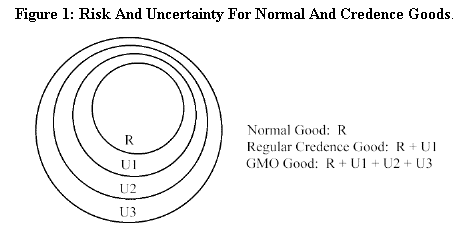
Fourth, there are amounts of both honest ignorance and perfidy that affect peoples' perception of risks of GMO products (area U3). Because the technology is highly complex, many people instinctively reject it as unwise or unacceptable; others willfully muddy the waters with outlandish claims about the impact of biotechnology (e.g., some attribute both the acquired immune deficiency syndrome (AIDS) and ebola to uncontrolled biotechnology experiments).
This presence of imperfect or asymmetric information causes market failure-the market fails to provide all the information required by consumers in order to make rational consumption decisions. Labeling is proposed by many as one way to remedy this market failure because it involves a transfer of knowledge from the supply-side to the demand-side of the market. Through the use of labels, the information gap between the industry and the consumers may be minimized. This can be a challenge, however, as GMO-labeled goods would bear the full cost of R+U1+U2+U3, which could more than offset any benefits and thereby impede further biotechnology development.
The use of labels also has implications for the international trade of GMOs. Foreign trade of GMO products requires two steps: first, foreign products must gain market access, usually by meeting the domestic standards and regulations, including those pertaining to the use of labels; and second, foreign products must compete against other products in the foreign market on price and attributes combinations. Although labeling is considered to be a remedy to a demand-side market failure affecting market competition, it can potentially limit the ability of products to gain market access and therefore may at times act as a technical barrier to trade. As there are no universal definitions of what constitutes risk to human safety, animal and plant welfare or the environment, countries may and often do disagree on the necessity for and type of information to be provided on labels. In the case of a disagreement, a product may be denied access to the foreign markets. Therefore, the use of labels to inform consumers in one country may be viewed by another country as trade protectionism. The result would be to limit the market size for GMO products, lowering potential returns and impeding further biotechnology investment.
Assessing GMO Labeling
Whether labeling is a threat or opportunity depends on the type of products being pursued and the degree of uncertainty for that product. It is useful to make a distinction between two general types of GMOs, namely:
- Process-based GMOs where biotechnology has been used to enhance productivity or yield for a good (e.g., RoundUp Ready or Bt varieties of canola, corn and soya). Because the end-use attributes have not been altered, the result may be a mixed supply of commodities that makes it impossible to differentiate biotechnology-based goods from non-biotechnology-based goods.
- Product-based GMOs where biotechnology has been used to alter the end-use attributes of a product. The product is differentiated in the marketplace as industry tries to develop a segmented, niche market. Therefore, the consumer will not have difficulty distinguishing a GMO product from a non-GMO product.
Labeling may be either a private or public good depending on the type of good involved. "Private-good" labeling policies are based on the assumption that industry wants to segment the market by identifying the GMO-based products. This may be done through voluntary labeling where consumers are provided with the information necessary to distinguish those products which use agricultural biotechnology from those that do not. "Public-good" labeling policies are based on the assumption that industry is unable or unwilling to identify the risks inherent in their GMO products. Therefore, the government intervenes in the market with mandatory labeling policies designed to identify the use of GMOs in products. In this capacity, the government is acting to ensure consumer protection from potential human health and safety risks associated with the consumption of GMOs.
Combining the definitions of process- and product-based GMO products with the notions of voluntary private-good and mandatory public-good labeling policies reveals significantly different outcomes and impacts (Table 1).
Case I: With mandatory labeling of process-based GMOs, producers would be forced to visibly label their goods (e.g., with a double helix to demonstrate presence of GMO) to signal that the good has been transformed using transgenic technologies, even though scientific tests may not be able to distinguish between the end-use attributes of the GMO and traditionally-produced good. In this case, producers would be forced to assume the costs of all the risks and uncertainties (R+U1+U2+U3 in Figure 1), with the result that they would likely suffer a discount for their good in the market, which would dampen the production and consumption of this product. This is not socially desirable as firms are required to bear through government action uncertainties related to the food safety system (U2) and misinformed judgment (U3). Corn, soya, and canola-significantly genetically modified already-are incorporated in more than 30,000 processed foods, as well as comprising a major source of animal feed. Therefore, labeling of this sort could seriously disrupt domestic and international food markets and would constitute a threat to the entire industry. Labeling issues related to this 'commodity' process-based use of biotechnology may only be a short-term issue as the trend is to use agricultural biotechnology increasingly to alter product attributes, where there exists a "private good" rationale for a voluntary, industry-led labeling policy.
Case II: With mandatory labeling of product-based GMOs, firms would face the same outcome as case I, except the cost to them could be greater. Producers of GMO products seek higher returns from the market for their distinguishable product. If the mandatory GMO label limits their ability to position their product, it would be a threat. Alternatively, if the label was inconspicuous and rules did not limit product positioning, then the results of Case IV might hold.
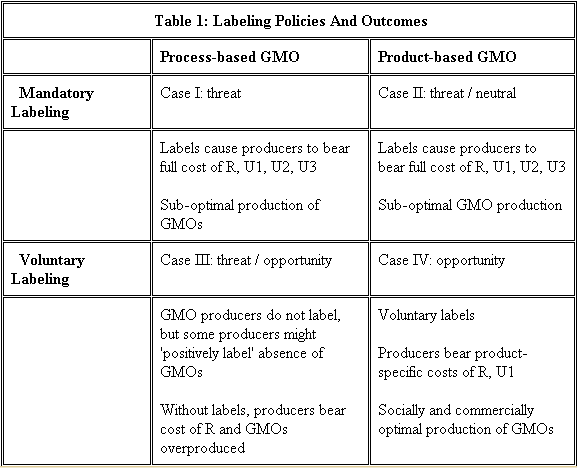
Case III: If labeling of process-based GMOs was left up to the discretion of the producer, it is highly unlikely that they would do any labeling, which, depending on the relative degree of credence uncertainty about the GMO (U1), could lead to significant over-production of the good, which would not be socially desirable. Choosing whether to impose mandatory labeling would depend on the relative weights one put on U1 versus U2 and U3. There is a real possibility that if U1 is large enough, producers of non-GMO products might choose to 'positively' label their goods as GMO-free, which would enable them to differentiate their product from GMO goods (allowing them to capture a 'product' rent), while also facilitating consumer sovereignty. Following the introduction of rBST for milk production in the US, a number of milk producers and processors of milk-based products marketed their goods as using milk produced without rBST, which allowed them to charge a premium in the market. In the global marketplace, Australian canola producers have already pursued this option to capture market lost by Canadian producers in the EU. They have marketed their canola to EU importers as guaranteed GMO-free (because Australia has not approved release of any GMO varieties). With positive labeling, voluntary labeling would be a socially optimal outcome.
Case IV: Voluntary labeling of GMO for products also appears optimal. Monsanto with its New LeafTM potato and Calgene with its Flavr SavrTM tomato both emphasized the biotechnology-base for the new product attributes. Although the Flavr SavrTM tomato was not commercially successful, it was because of a poor choice of tomato germplasm and not because consumers rejected it as a GMO. As long as consumers can see a personal benefit of the new technology, they appear willing to buy. This would be socially optimal, with both producers and consumers gaining from the introduction of new products.
Conclusion
Labeling goes to the heart of private sector, biotechnologically-based research and development in the agri-food business. Mandatory labeling is clearly a threat to the continued development of biotechnology products and processes. Nevertheless, in the absence of industry action to positively label, governments may be pushed by consumers and various lobby groups to impose mandatory labeling to ensure firms are held accountable for the product-specific credence uncertainties.
References
Bureau, J-C., Marette, S., & Schiavina A. (August 1997). Trade, labels and consumer information: The Case of hormone-treated beef. [Contributed Paper.] XXII Conference of IAAE. Sacramento.
© 1998 Peter Phillips & Grant Isaac
Suggested Citation: Phillips, Peter and Grant Isaac. (1998). GMO labeling: Threat or opportunity? AgBioForum, 1(1), 25-30.


Previous Notes |
|
| Read | |
 |
 |
|
