Site-Specific Irrigation Management
Efficiency variable-rate irrigation controls for center-pivot irrigation to enhance water use.
What is Variable-Rate
Irrigation?
Variable-Rate Irrigation (VRI), also called site
specific or precision irrigation, is a relatively new concept in agriculture.
Variable-rate irrigation is a tool of Precision Agriculture that involves the
delivery of irrigation water in amounts that match the needs of individual areas
within fields.
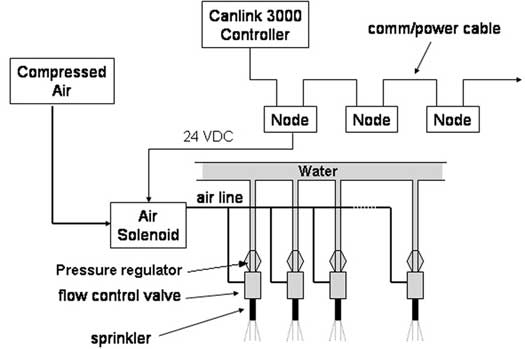
| Figure 1. Layout of VRI control system. |
Most center-pivot (CP) irrigation systems currently in use apply a constant rate of water. Some systems can provide variable application rates in wedge-shaped sections of a field by varying the travel speed of the system through those areas. However, the ability to vary application rates over segments in an entire field has not been possible with current systems. With VRI, each area in a field can receive the proper amount of irrigation water.
Do I need VRI?
Very few fields are uniform -
most have variable topographic and soil conditions with corresponding soil water
variations (water holding capacities, drainage rates, infiltration rates). Many
CP systems do not make complete circles or overlap other pivots. Similarly, many
CP systems have areas, such as waterways, ditches, ponds, or roadways, that are
not cropped and do not need to be watered. Other fields may be irregularly
shaped or have multiple crops planted. All of these scenarios could benefit from
a system with the ability to apply varying amounts of irrigation water to
specific areas in a field.
One should not immediately assume that they must purchase new hardware to implement VRI. Some things that could be done inexpensively include:
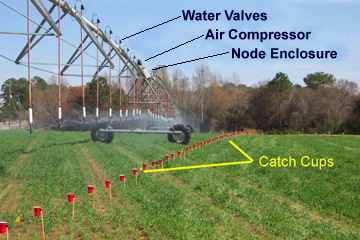 |
| Figure 2. Catch cups used in NESPAL VRI system testing. |
How does VRI work?
Researchers have been
working for several years on systems to control water application rates from
either individual sprinklers or groups of sprinklers. The VRI system being
developed by University of Georgia researchers at NESPAL varies water
application by a combination of pivot speed control and cycling sprinklers on
and off. For example, to halve the application rate of a sprinkler at any given
speed the sprinkler would be turned off for 30 seconds each minute. To double
the rate the rotation speed of the pivot would be halved. It is possible for
part of the pivot boom to be applying double the normal rate and another part
applying half the normal rate (or less). It’s simply a matter of the computer
controller manipulating both pivot speed and sprinkler cycle time.
The NESPAL VRI system
NESPAL installed a
standard 4 tower, 600 foot Reinke CP irrigation system and then retrofitted it
with a VRI control system. The CP can be controlled either by the manufacturer’s
control panel or the new VRI system. The Farmscan group (http://www.farmscan.com/) has
been a partner on this project. Compressed air is used to control the
sprinklers, reducing the likelihood of clogged valve orifices common with
electrical solenoid valves.
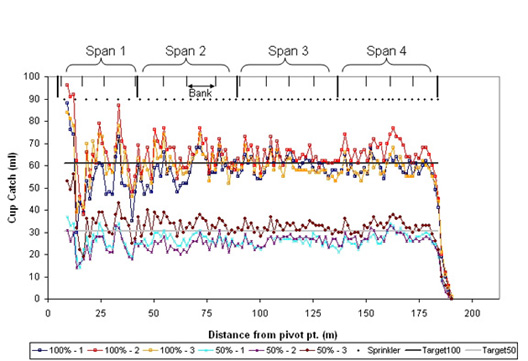 |
| Figure 3. Results of 100% and 50% testing of NESPAL pivot. |
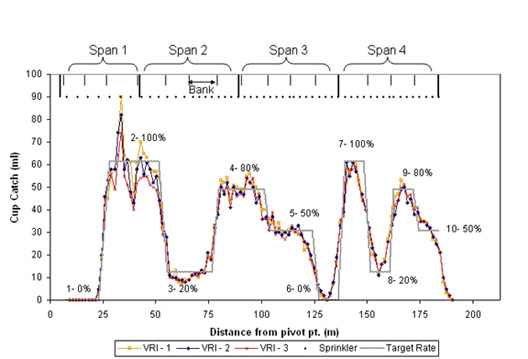 |
| Figure 4. Results of variable-rate testing of NESPAL pivot. |
The major components of the NESPAL VRI system (Figure 1) include:
Desktop software allows management zones to be defined under the CP and then uploaded to the main controller. The pivot boom is segmented by grouping sprinklers in 15 banks (with either 2, 3, or 4 sprinklers each). The end gun is also VRI controlled. To ensure flow uniformity when some sprinklers are off, pressure regulators are present at each sprinkler.
Performance of the VRI system To measure the performance of the NESPAL VRI system, a test was devised using catch cups along the entire length of the mainline. Three test patterns (uniform at 100%, uniform at 50%, and VRI) were each repeated three times. Plastic cups, placed every 5 ft, were held by rings about 1 ft above the soil surface (Figure 2). In Figure 3, the data shows the “100%” or normal rate had good uniformity. Similarly, the “50%” application rate also has good uniformity, showing that cycling sprinklers on/off to vary application rate did not alter the uniformity. In Figure 4, the “VRI” data points reflect the test results with sprinkler banks set to various target application rates. The graph shows good correlation between actual and target application.
Future Directions
The NESPAL VRI control
system has been installed on 4 additional CP systems on grower fields, and
another has been installed at the University of Georgia Stripling Irrigation
Research Park, near Camilla, Georgia.
One VRI installation was notable in that it was a partial installation. Only the last span, overhang, and end-gun have VRI controls. This type of installation was used because the primary aim was to reduce overlap irrigation with a neighboring CP.
The currently installed systems will be monitored over the coming seasons to judge their performance and reliability. We should soon know more about the economic and environmental impacts of VRI. These systems will be used as models for water conservation and Precision Agriculture extension activities. The knowledge gained from their operation should help farmers, waste applicators, and researchers decide whether or not VRI is a viable option in the context of their irrigation operations. For more information please see http://www.nespal.org/PrecAg/vri.asp.