Site-Specific Soil Sampling
Improving the way you soil sample for maximum variability.

Issue
Soil sampling is generally not practiced
often enough by Texas producers, and the tradition of sampling strategy has not
been evaluated in many years. Improper soil sampling can result in incorrect
fertilizer applications, loss of production and profits, as well as nitrate
contamination of groundwater. Animal waste applications to cropland is another
important soil nutrient issue. Excessive manuring without proper soil sampling
can result in nitrogen and phosphorus imbalances and contamination of surface
waters. Nutrient contamination of ground- and surface waters is a pressing
environmental concern in Texas and other parts of the country. Finally, global
positioning system (GPS)-referenced variable-rate fertilizer equipment is
becoming more available, and economical soil sampling approaches for this
technology are needed.
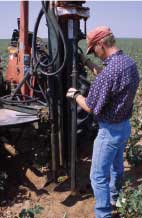
What We Have Learned
Depth to soil sampling is the first
concern. Historically in Texas, soil sampling for nitrate and nitrogen
fertilizer recommendations has been done to 6 inches. Our project has shown that
this practice can greatly over-estimate fertilizer recommendations by ignoring
the often high levels of residual nitrate-nitrogen in clayey subsoils of the 6
to 24 inch layer. By thorough soil sampling of five farmers’ fields between 2000
and 2002 in Yoakum, Hockley, Lamb, and Hale counties, we have found that there
can be nearly four times the amount of nitrate-nitrogen in the 6 to 24 inch soil
layer (average of 70 lb nitrate-nitrogen/ac) as in the 0 to 6 inch top layer
(just 18 lb nitrate-nitrogen/ac). Soil sampling to 6 inches is sufficient for
phosphorus, potassium, micronutrient, and pH analysis. However, since phosphorus
fertilizer is often band-applied, it is important that all positions in the
field, i.e. bottom of furrow, side of bed, and top of bed, be sampled and
composited.
Where to take soil samples in the field is the second major issue. Grid soil
sampling from 0.5 acre to 2.5 acre-grid has been used by researchers and 2.5
acre-grid is used by commercial fertilizer applicators to produce soil test
maps. Variable-rate fertilizer application is a service that is now being
offered by commercial applicators in the Southern High Plains of Texas. However,
grid-soil sampling has received criticism as a practice that a producer could
not be able to do profitably. Therefore, there has been interest in “management
zone”– based soil sampling. Results from our research show that “directed” soil
sampling from management zones based on soil type, landscape position, and/or
zones in yield maps can be as effective as grid soil sampling. Specifically,
four to six soil samples can be taken from each zone and composited, so that one
soil sample from each zone can be sent to a state or private soil testing
laboratory for analysis. With this approach, producers can apply different rates
of fertilizer to a small number of zones.
Fertilizing by zone is “doable”,
even without variable-rate equipment, if soil tests in certain zones recommend
no fertilizer application. For producers with variable-rate fertilizer
equipment, less or no fertilizer can be applied to zones testing high in soil
nutrients. Similarly, higher fertilizer rates should be applied to zones with
low soil test values.
The Benefit
The management zone approach to soil
sampling and deep soil sampling are easy to understand and to implement. These
improved strategies can result in substantial reductions in farmers’ fertilizer
application rates and associated costs. Seventy lb nitrate-nitrogen/ac is
probably a typical nitrate-nitrogen level in the 6 to 24 inch layer of High
Plains soils, nitrogen that can only be realized by soil sampling to 24 inches.
This represents a savings of $17/ac that is needlessly applied as fertilizer
nitrogen.
Site-specific soil nutrient management approaches are especially beneficial in identifying “hot spots” of nutrients, such as areas where animal wastes have been applied. These approaches will also mitigate excessive nitrate buildup in the subsoils of the High Plains, and minimize leaching to the groundwater. Avoiding excessive phosphorus fertilizer applications by “site-specific” soil sampling and fertilization can help minimize movement of phosphorus in runoff to surface waters. As of the 2002 growing season, we know of at least two prominent area crop/soil consultants who are presently doing deep soil sampling and zone soil sampling in Castro, Hale, and Lamb counties. The Texas Agricultural Experiment Station is promoting these improved soil sampling strategies so that their adoption widens.